
An IEP is a promise written down: goals to work toward, services to deliver, minutes to account for, meetings to hold, and a parent who deserves to know where things stand. The promise is easy to make. Keeping it is a paperwork problem, and that is exactly what an iep planner is for — a system, not more effort.
Most special education teachers do not lose track of an IEP because they do not care. They lose track because the pieces live in five different places: goals in one binder, service minutes in a spreadsheet, meeting notes in a notebook, the caseload list on a sticky note, and the parent's questions in an email thread. An iep planner that holds the pieces together is not a luxury. It is the difference between a caseload you manage and a caseload that manages you.
This toolkit brings five pieces together. Each one works on its own, and each one is stronger with the others beside it. Start with the piece that hurts most, then add the rest as the year goes on.
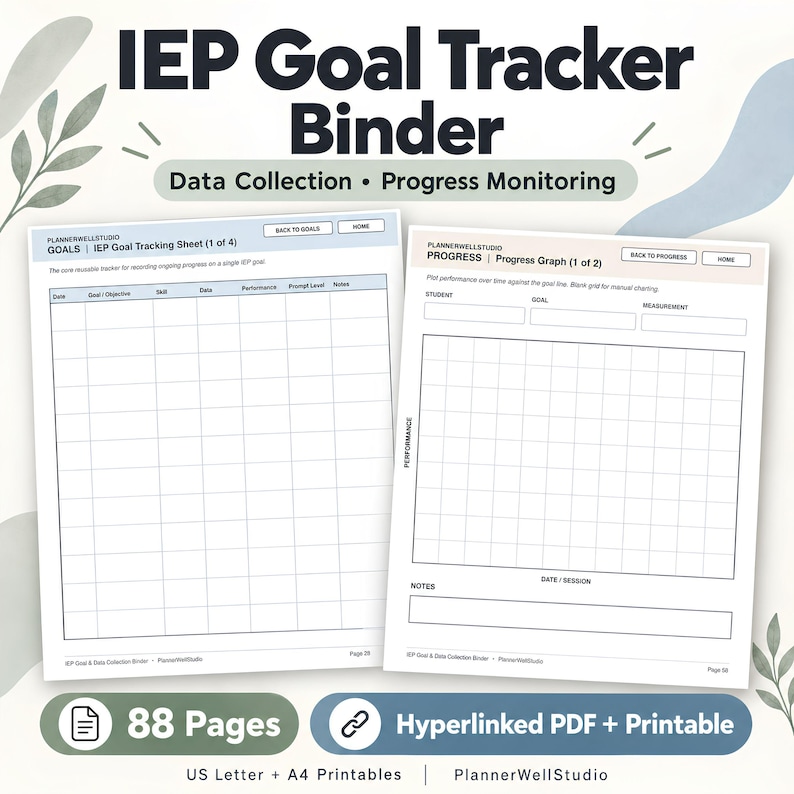
1. IEP Goal Tracker Binder — one page per goal
Goals are the heart of the IEP, and they are also the hardest thing to track. A goal is not a single number; it is a baseline, a target, and a long line of small measurements in between. The IEP Goal Tracker Binder is built around that shape: one page per goal, with the goal as written, the baseline, and the target at the top, and the data underneath. The binder is an 88-page hyperlinked PDF, with goal sheets that include benchmarks and objectives, data collection forms in several formats — trial-by-trial sheets, frequency and duration recording, accuracy and percentage records — plus progress monitoring logs and graph templates on the same pages as the data, so the trend is visible in five seconds. Meeting pages and caseload planning pages sit at the back. Printable US Letter and A4 versions are included, and the hyperlinked version works on a tablet for teachers who collect data on the move. It suits special education teachers and case managers who want the goal — not the grid — to be the unit of tracking.
Shop the IEP Goal Tracker Binder:
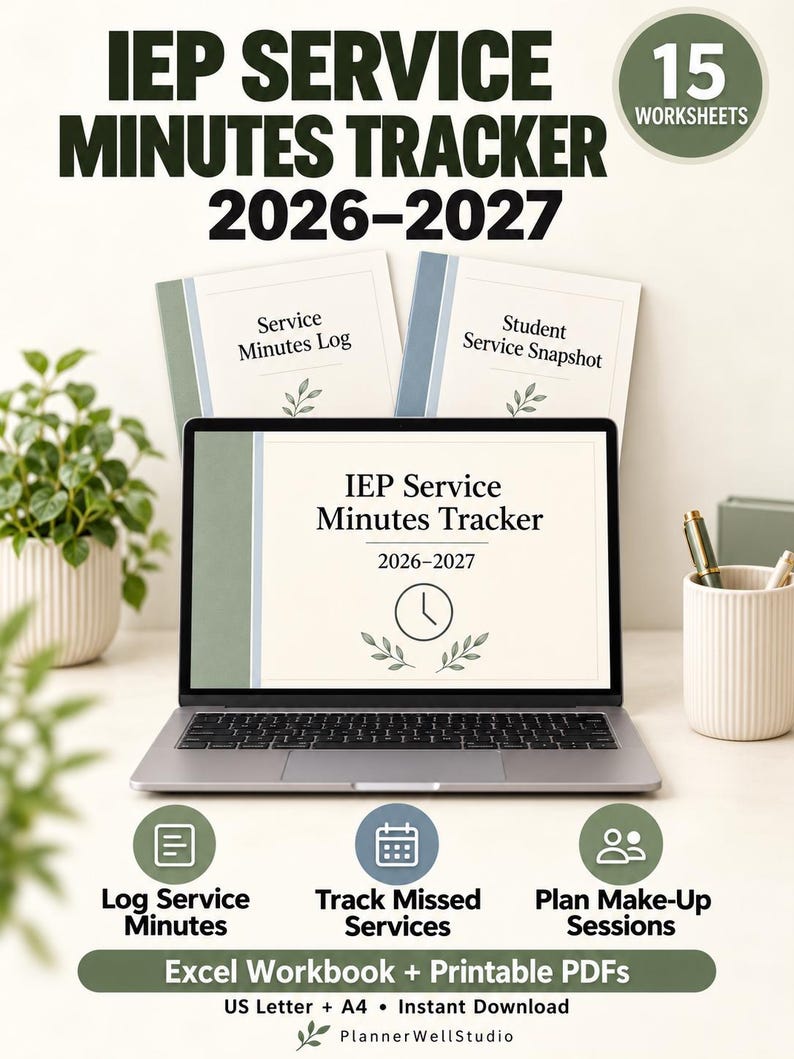
2. IEP Service Minutes Tracker — every minute accounted for
Services are where IEPs most often drift. A session gets missed, a make-up gets promised, and three weeks later nobody can say which minutes were delivered and which are still owed. The IEP Service Minutes Tracker is a 15-sheet Excel workbook for the 2026–2027 school year that keeps scheduled, delivered, missed, and make-up minutes in one place. It holds students, providers, and services, a service schedule, and a minutes log, with weekly, monthly, and annual summaries, a missed-services sheet, a make-up services sheet, and a dashboard that shows the picture at a glance. Built-in dropdowns, automatic calculations, and conditional formatting keep entries consistent, and no macros are needed. A 9-page printable PDF version comes in US Letter and A4 for anyone who wants the log on paper. It is made for special education teachers, case managers, resource teachers, and coordinators who have to answer, at any moment, whether services were delivered as written.
Shop the IEP Service Minutes Tracker:
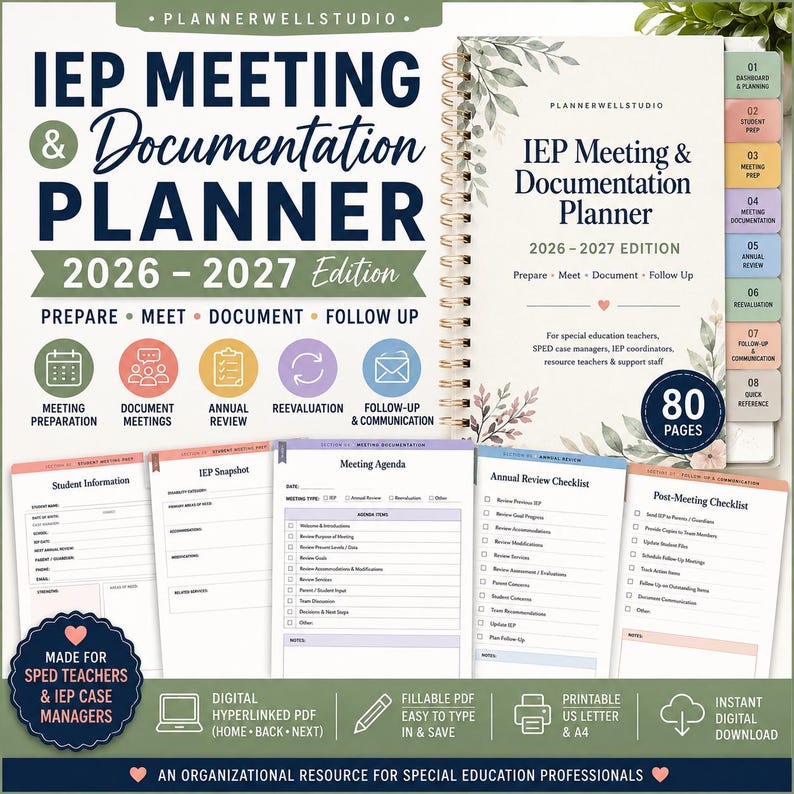
3. IEP Meeting Planner — walk in prepared
A meeting goes well when the preparation is done before the room fills. The IEP Meeting Planner is the place that preparation happens: the student's goals and current data in one spot, the agenda for the meeting, the notes taken while people talk, and the decisions and action items that come out of it. Instead of hunting through three binders the morning of the meeting, the case manager opens one planner and has the story of the student ready — what has moved, what has stalled, and what needs deciding. It suits any teacher or case manager who chairs or attends IEP meetings and wants the meeting to end with clear next steps instead of a pile of loose notes.
Shop the IEP Meeting Planner:
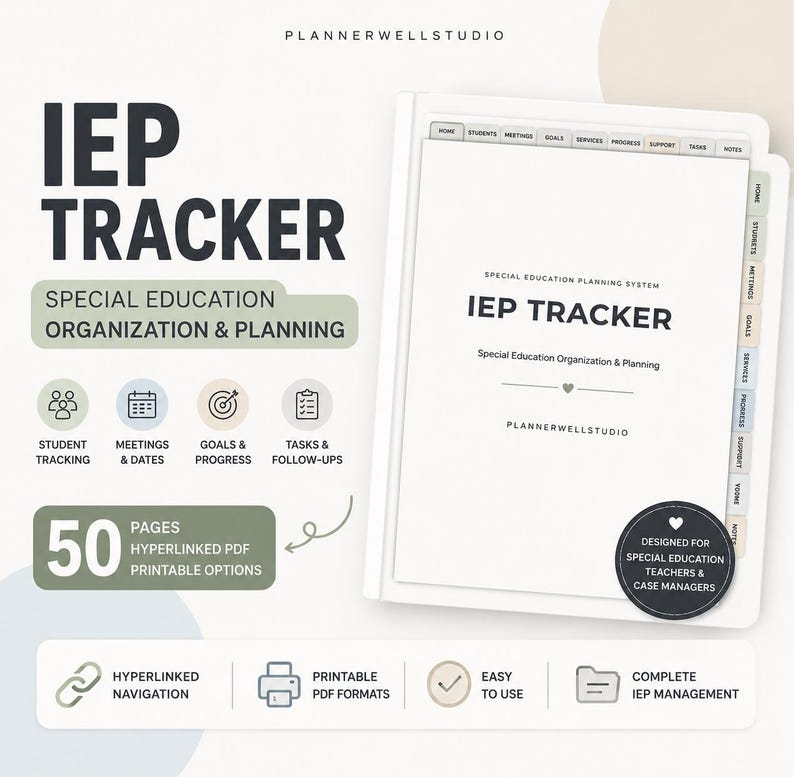
4. IEP Tracker for Special Education Teachers — the whole caseload at a glance
A caseload is not one student; it is twenty or thirty, each with their own goals, services, and dates. The IEP Tracker for Special Education Teachers keeps the caseload on one system: who the students are, which goals belong to whom, which services are due, and which dates are coming up. When a parent calls, the answer is on the page instead of in a search through files. When progress report week arrives, the tracker shows which students are ready and which need data first. It is the piece that turns four separate tools into one working system, and it suits any special education teacher carrying a caseload that is too big to hold in memory.
Shop the IEP Tracker for Special Education Teachers:
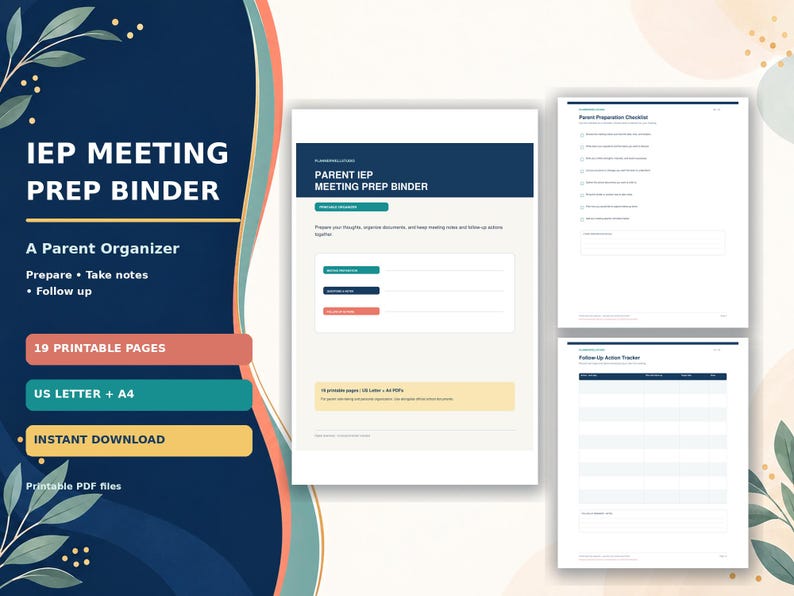
5. IEP Meeting Checklist for Parents — for the other side of the table
An IEP meeting works best when parents arrive prepared, and preparation is hard when nobody tells you what to bring. The IEP Meeting Checklist for Parents is the parent-facing piece of this toolkit: a checklist that helps a parent gather the right records, write down their questions, note their child's strengths and concerns, and leave the meeting with decisions and follow-up dates written down. Teachers can share it with families before a meeting so everyone walks in with the same preparation. It is also on Payhip as the Parent IEP Meeting Prep Binder, for families who prefer that shop.
Shop the IEP Meeting Checklist for Parents:
Build your iep planner toolkit one piece at a time
You do not need all five pieces on the first day. If goals are the mess, start with the Goal Tracker Binder. If service minutes are the worry, start with the Service Minutes Tracker. If meetings run long and end vague, start with the Meeting Planner. Add the next piece when the first one is working, and by the second term the toolkit is not five separate products — it is one system, and the caseload runs on it instead of on memory and sticky notes.



0 Comments