
An iep meeting checklist is the difference between a meeting you survive and a meeting you lead. Without one, you walk in carrying a stack of papers, a half-remembered set of numbers, and a hope that nobody asks about the goal you have not checked since September. With one, you walk in with the data, the decisions you need, and a clear record of what was agreed before you leave the room. The meeting itself is rarely the hard part. The preparation is, and the follow-up after it is where most plans quietly fall apart.
This checklist covers all three parts: before the meeting, during it, and after it. It is built for case managers and special education teachers, and it works just as well for an annual review as it does for a smaller progress meeting.
Your IEP Meeting Checklist: Before the Meeting
Preparation starts at least a week before the meeting date, not the night before. Work through these items in order:
- Pull the current goals, as written. Copy each goal exactly, with its benchmarks or objectives. If you are working from memory or a shortened version, you are already guessing.
- Gather the latest data for every goal. Bring the most recent data points, not just the average. A graph that shows the trend is worth more than a single percentage, because the team needs to see whether the student is moving, stalling, or sliding.
- Note what has changed since the last meeting. New services, a schedule change, a behavior plan, a new accommodation that is or is not working. The team cannot plan around changes it does not know about.
- List the decisions you need from this meeting. A goal to revise, a service to add or change, an accommodation to test, a placement question to discuss. Write them down before you sit down, or the meeting will decide its own agenda.
- Check the paperwork. The invitation list, the meeting notice, any assessments or reports that must be shared in advance, and the draft goals if your school shares them beforehand. Missing paperwork is the most avoidable reason a meeting gets rescheduled.
- Prepare one page per student to bring in. A short summary — goals, current data, strengths, concerns, and the decisions you need — keeps the conversation focused when the full file is twenty pages long. My post on IEP at a Glance explains how to build that page, and my IEP Goal Tracker post shows how to keep the data behind it current all year.
The point of this stage is simple: no surprises for you in the room. If a number might be asked about, have it in front of you. If a goal might be questioned, know its data before anyone else does.
During the Meeting: Run the Checklist, Not Just the Agenda
Once the meeting starts, your job is to keep the record straight while the discussion moves. Use the same structure every time:
- Confirm the goal list first. Go through each current goal and confirm whether it stays, changes, or closes. Do not let a goal drift past without a decision.
- Present data goal by goal. State the baseline, the current level, and the trend in one or two sentences each. Short and factual beats long and defensive, especially when progress is slow.
- Name the concern plainly when progress has stalled. A stalled goal is information, not failure, but only if the team hears about it in the meeting. Say what you have tried, what the data shows, and what you propose changing.
- Write down every decision as it is made. Who does what, by when, and how it will be measured. If a decision is not written down in the meeting, it will be remembered three different ways afterwards.
- Check services and accommodations against reality. Is the service actually happening as written? Is the accommodation being used in class, or does it only exist on paper? The meeting is the time to fix the gap between the plan and the classroom.
- Ask the parent or guardian what they are seeing at home. Homework, confidence, behavior after school, anything that does not show up in your data. That view often explains a trend your numbers only hint at.
Keep your notes on the goal pages themselves, not on loose paper you will lose by Friday. When each goal has its own page with its data and graph, the meeting notes sit exactly where the next progress report will need them.
After the Meeting: Close the Loop the Same Day
The meeting is not finished when everyone leaves the room. It is finished when the record is complete and the next steps are moving. Do these before the day ends:
- Transfer every decision to the goal pages. Update the goal, the service, or the accommodation the same day, while the wording is still fresh.
- Send the follow-up notes. A short summary to the team and the family: what was decided, who is responsible, and what happens next. This one email prevents most later misunderstandings.
- Set the next check date for each changed goal. A revised goal without a check date is a promise without a plan. Pick a date four to six weeks out and put it in your tracker.
- File the paperwork where you can find it. The signed pages, the meeting notes, and the updated summary go in the same place every time, so the next meeting starts from the last one instead of from scratch.
Teachers who follow this routine say the same thing about their meetings: they get shorter, calmer, and more useful. Not because the meetings themselves changed, but because the preparation removed the scrambling and the follow-up removed the loose ends.
The One Habit Behind the Whole Checklist
If you take only one habit from this iep meeting checklist, take this: keep one page per goal, updated where the teaching happens, all year long. Then meeting preparation is not a week of reconstruction. It is an hour of gathering pages that already exist, and the meeting itself becomes a conversation about the student instead of a search for the data.
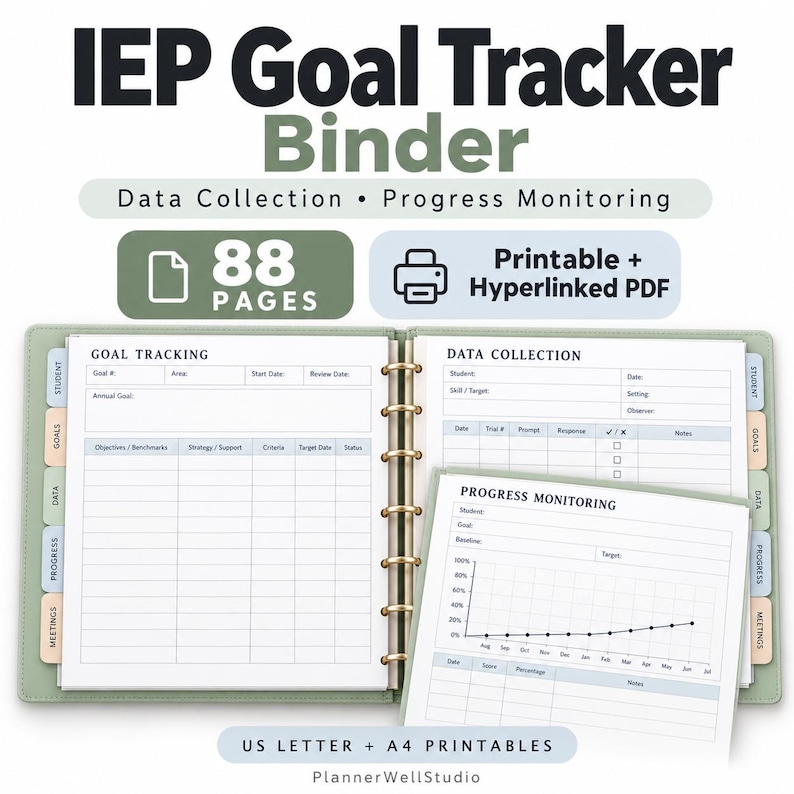
Ready-to-use help: If you want the goal sheets, data collection forms, progress graphs, meeting pages, and caseload planning ready to use, the IEP Goal Tracking Binder is an 88-page hyperlinked PDF built for exactly this system — with printable US Letter and A4 versions included.
Browse all teacher planners here: https://www.etsy.com/shop/PlannerWellStudio
Start with your next meeting. Pull the goals, gather the data, write down the decisions you need, and walk in prepared. When you walk out with every decision written down and a check date for each one, you will feel the difference immediately.
Read next
IEP Goal Tracker: How to Track IEP Goals Without a Spreadsheet Headache
IEP Progress Reports: Collect Data All Quarter So Report Week Is Easy



0 Comments