
The washing machine stops mid-cycle on a Tuesday evening, full of water and laundry. The repair technician comes the next day, looks at it for ten minutes, and quotes a price that makes you wince — then asks the question that decides everything: "Is it still under warranty?" You think it might be. You bought it less than two years ago, and you remember the shop mentioning a two-year warranty. But the receipt is somewhere in a drawer, or a folder, or possibly thrown away, and the manual with the warranty terms is in a box you have not opened since moving day. So you pay for the repair, and three weeks later you find the receipt: the warranty had another four months to run.
That is the whole problem an appliance warranty tracker solves. It is not a complicated system. It is one place where every appliance you own is listed with the details a warranty claim will ask for — brand and model, serial number, purchase date, where the receipt is kept, and the date the warranty ends — so that when something breaks, the answer to "is it still under warranty?" takes thirty seconds instead of an afternoon of searching.
How an Appliance Warranty Tracker Works
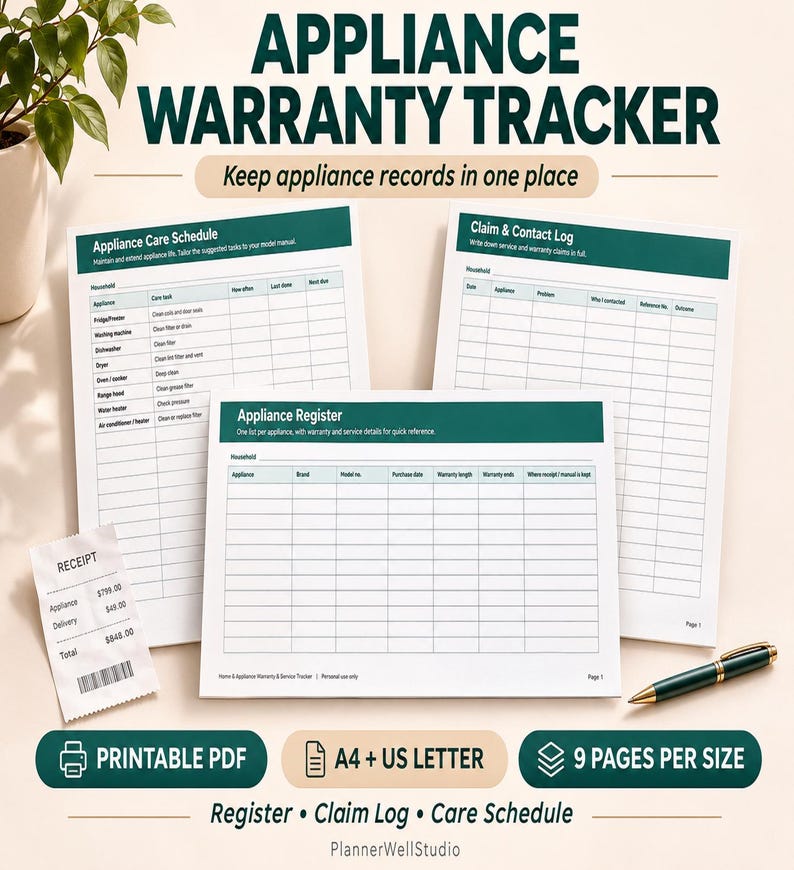
An appliance warranty tracker is a set of printed pages you fill in by hand and keep in one binder or folder. The heart of it is the Appliance Register: one row per appliance, with columns for the appliance, brand and model, serial number, purchase date and price, where you bought it, the warranty length, the warranty end date, and where the receipt and manual are kept. That last column matters more than it looks — a warranty you cannot prove is a warranty you cannot use, and the register tells you exactly which drawer, folder or file holds the proof.
Around the register sit the working pages. The When-You-Buy Checklist is the page you fill in the day a new appliance arrives, while the box is still on the floor and the details are in front of you. The Claim Log records every problem you report. The Service & Repair Log records every visit. The Care Schedule tracks the routine upkeep that keeps appliances alive — filter changes, descaling, cleaning — and the Manuals & Receipts Index tells you where every document lives. One filled example page shows a register completed with fictional appliances, so you can see what a finished entry looks like before you write your first real one.
The When-You-Buy Checklist: Five Minutes That Save a Claim
Most warranty claims fail on missing details, not on the terms. The manufacturer asks for the model number, the serial number, the purchase date and a proof of purchase, and if any of those is missing the claim stalls. The When-You-Buy Checklist exists so those details are captured when they are easiest to get: the day the appliance arrives.
Walk through it with the box open. Write the brand and model from the box or the rating plate, and the serial number from the sticker on the back or inside the door — it is always in the awkward place, so copy it now while the appliance is still out in the open. Write the purchase date and the shop, and note the warranty length from the paperwork: one year, two years, or a longer manufacturer term plus any extended cover you bought. Then write down where the receipt goes and where the manual goes, and put them there straight away. Finally, register the warranty if the manufacturer asks for it — some warranties only start counting once the product is registered — and note the registration date on the checklist.
Five minutes, once, per appliance. Compare that with the afternoon spent hunting for a serial number on a washing machine that is already plumbed in and full of water.
The Claim Log: What to Write When Something Breaks
When an appliance breaks, the first call is stressful enough without having to remember what you said to whom. The Claim Log is where the claim lives from the first phone call to the final repair, and each entry takes a minute.
Write the date you first noticed the problem and what the appliance was doing — "fridge making a loud buzzing noise, freezer still cold" is more useful than "fridge broken," because the technician will ask. Write who you called, the number you used, the name of the person you spoke to, and any reference or case number they gave you. Note what they promised — a callback, a visit, a part ordered — and the date they promised it by. Then, when the visit happens, add what the technician found and what was done, and whether the repair was covered.
The reason for all of this is simple: warranty claims are slow, and slow processes are forgotten. A claim that takes three weeks involves two or three phone calls, and by the third call nobody remembers what the first person promised. The log remembers. It also protects you: if a repair that should have been free is charged for, the log is the record of what was agreed, with dates, and that is what gets a charge reversed.
The Service & Repair Log and the Care Schedule
Not every repair is a warranty claim. Appliances also need visits that you pay for, and those visits have their own history worth keeping. The Service & Repair Log records each one: date, what was done, who did it, what it cost, and whether any parts were replaced. Over a few years this becomes the real story of an appliance — the fridge that has needed three repairs in two years is telling you something, and the log shows it in one glance when the next repair quote arrives and you have to decide whether to fix it or replace it.
The Care Schedule covers the other side: the small jobs that prevent the big ones. Filters changed, seals cleaned, descaling done, vents cleared. These are the tasks that slip because nobody writes them down, and a missed filter change can quietly shorten an appliance's life by years. The schedule lists each task, how often it is due, and the date it was last done, so the next due date is always visible. It takes two minutes to check and it is the cheapest maintenance there is.
The Manuals & Receipts Index: Finding the Paperwork in Thirty Seconds
Every household has a version of the same drawer: manuals, warranty cards, receipts and leaflets, all in one place, none of them findable. The Manuals & Receipts Index fixes that without reorganizing anything. It is a single list: appliance, where its manual is kept, where its receipt is kept, and any extra paperwork — an extended warranty certificate, a registration confirmation, a service plan.
You do not need a perfect filing system for this to work. The receipt can stay in the drawer and the manual can stay in the box in the cupboard. What matters is that the index says which drawer and which cupboard, so that when the washing machine stops on a Tuesday evening, you walk straight to the right place instead of emptying three drawers onto the kitchen floor. Fill the index in once, when you set up the register, and update the one line that changes whenever a new appliance arrives.
A Worked Example (Fictional Appliances)
The example page in the pack shows a filled register with fictional appliances, and it is worth studying before you start, because it shows how little each entry needs. A fictional washing machine: brand and model written out, serial number copied from the rating plate, purchased 14 March 2025, two-year manufacturer warranty ending 14 March 2027, receipt in the kitchen filing box, manual on the shelf above the machine. A fictional fridge: purchased 2 June 2024, five-year extended cover, receipt photographed and stored with the household papers, manual in the same folder. A fictional kettle: one-year warranty, receipt in the same box, no registration needed.
Notice what the example does not contain: no account numbers, no passwords, no personal details. The register holds product details and dates, nothing that would matter if someone else saw it. Keep it that way — write appliance details, not your private information, and keep the pages in your own home.
The Mistakes an Appliance Warranty Tracker Prevents
The mistakes are quiet ones, and they all cost money. The warranty that expired unnoticed because nobody wrote the end date down. The claim that stalled because the serial number was on a sticker nobody could reach. The receipt thrown away with the box on delivery day. The repair paid for twice because nobody recorded that the same fault had already been fixed under warranty six months earlier. The appliance replaced when a free repair was available, because nobody could prove the warranty was still running.
None of these need a new app or a subscription to fix. They need a page, a pen, and the five minutes it takes to write an appliance down when it arrives. An appliance warranty tracker is the cheapest insurance there is: nine pages, two paper sizes, and a habit that takes minutes a year. It does not change what your warranty covers — only the manufacturer's terms do that, and you should always read them — but it makes sure that when the cover is there, you can actually use it.
Ready-to-use help: If you want the full tracker ready to print, the Appliance Warranty Tracker Printable was built for exactly this habit — a 9-page printable PDF in A4 and US Letter, with an appliance register, when-you-buy checklist, claim log, service and repair log, care schedule, manuals and receipts index, and a filled example page. The same tracker is also on Payhip here: https://payhip.com/b/OoxkK and on Gumroad here: https://durakhshanirfan.gumroad.com/l/mflng
Warranty terms differ by product and country. Read each warranty document for what it actually covers. These pages are record-keeping tools and do not give legal advice. They do not replace the manufacturer's warranty terms or your consumer rights.
Browse all teacher planners here: https://www.etsy.com/shop/PlannerWellStudio
Start with the appliance nearest you. Write down its brand, model and serial number, find the receipt, and work out when its warranty ends. Then do the next one. By the end of the weekend, every appliance you own will be on one page — and the next time one breaks, you will know in thirty seconds whether the repair is free.



0 Comments