
A calm classroom is not a quiet classroom. It is a classroom where everyone knows what happens next, what is expected of them, and what to do when something goes wrong. That kind of calm is not a personality trait. It is a system — a set of routines, charts, and records that run the same way every day, so the teacher is not inventing the day from scratch each morning. That is what good classroom management is: a system that runs the same way every day.
Classroom management fails most often in the gaps: the routine nobody taught, the job nobody owns, the behavior nobody wrote down, the seat that changes every day, the schedule that lives only in the teacher's head. These five tools close those gaps one by one. Each works on its own, and together they are a full classroom management system for grades K–5.
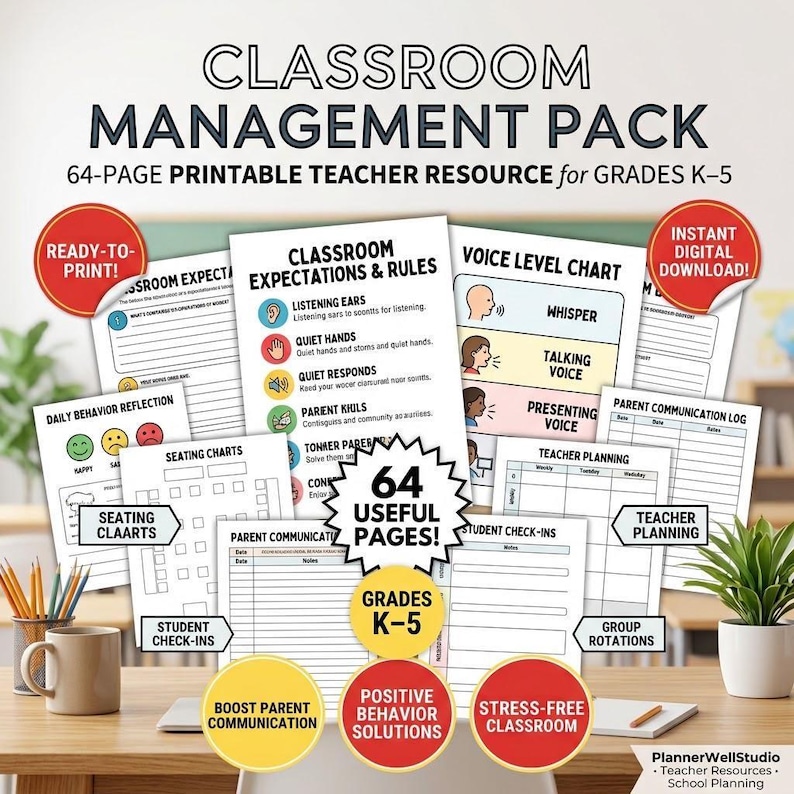
1. Classroom Management Pack — the whole system in 64 pages
Start with the pack that holds everything. The Classroom Management Pack is 64 printable pages for grades K–5: classroom expectations and rules, class agreement pages, a voice level chart, attention signal pages, daily and weekly behavior reflection, student check-ins and behavior trackers, classroom seating charts, flexible seating plans, group rotation planners, student organization checklists, desk and folder checklists, a parent communication log, meeting notes, a teacher follow-up tracker, weekly and monthly classroom planning, classroom community pages, and kindness and goal-setting pages. A 5-page teacher guide explains how to use it, with ideas for K–2 and for grades 3–5, and a printing guide and a master checklist are included. It is made for elementary teachers, homeschool educators, and classroom aides who want one pack that covers setup, routines, and everyday planning instead of five separate downloads.
Shop the Classroom Management Pack: Shop on Etsy
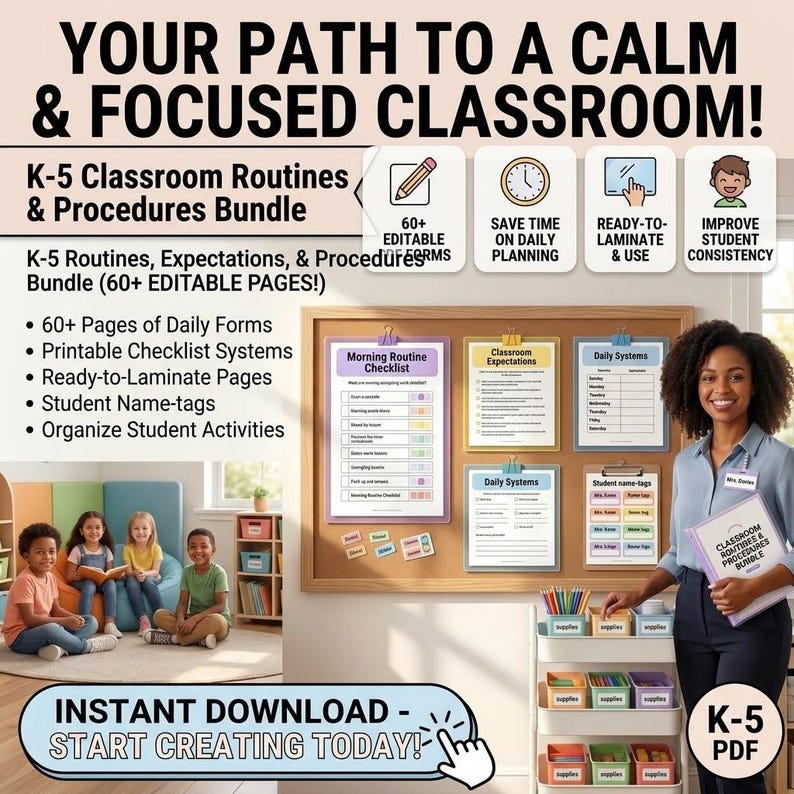
2. Classroom Expectations & Procedures — teach the routines first
Every management problem in October is a routine that was never taught in August. The Classroom Expectations & Procedures pack is for the first weeks of the year, when the class learns how the room works: how to enter, where things live, how to ask for help, what the voice levels mean, and what happens when the plan changes. When expectations are written down, posted, and revisited — not just announced once — students can meet them, and the teacher can point to the page instead of repeating the rule for the tenth time. It suits any teacher setting up a new class, taking over a class mid-year, or rebuilding routines that have slipped.
Shop Classroom Expectations & Procedures: Shop on Etsy
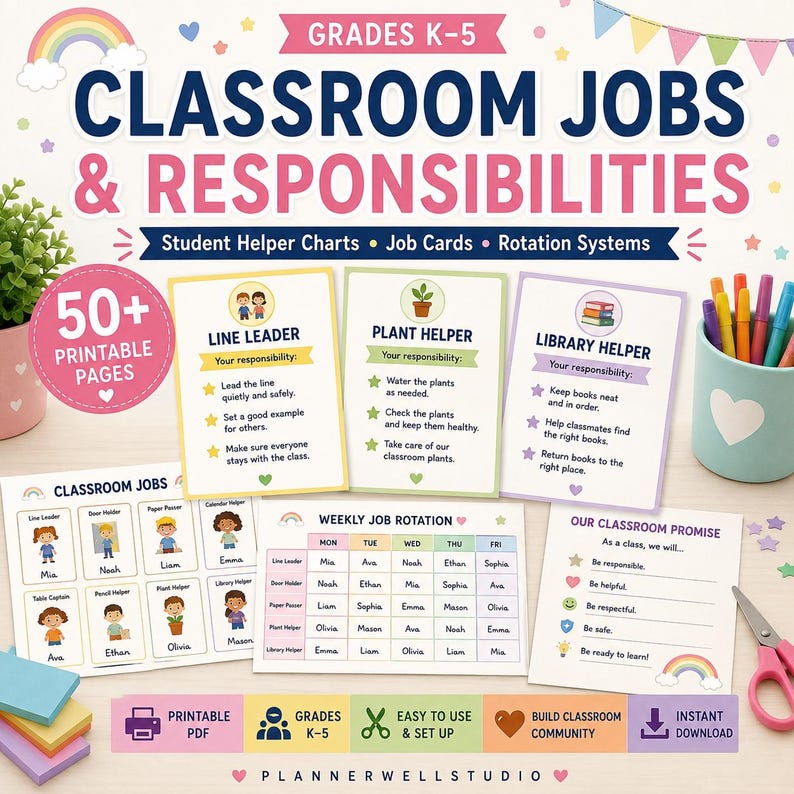
3. Classroom Jobs & Responsibilities Pack — give every student a job
A student with a job is a student with a reason to care about the room. The Classroom Jobs & Responsibilities Pack turns classroom upkeep into real roles — handing out materials, keeping the library tidy, leading the line, checking the calendar — with charts that show who does what and when the jobs rotate. Jobs do three things at once: they spread the work so it does not all fall on the teacher, they teach responsibility in a way a poster never will, and they give restless students a legitimate reason to move. Rotate the jobs regularly, keep the chart where everyone can see it, and the room starts to run itself in the small ways that matter.
Shop the Classroom Jobs & Responsibilities Pack: Shop on Etsy
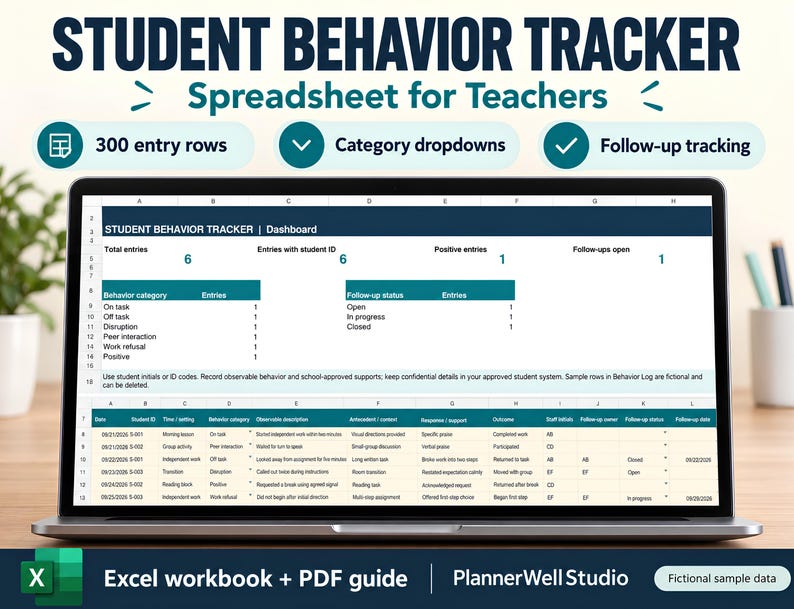
4. Student Behavior Tracker — write it down while it is fresh
Behavior you do not record is behavior you have to reconstruct later, usually from memory, usually badly. The Student Behavior Tracker is a simple record: what happened, when it happened, what came before it, and what followed. Kept daily, it shows patterns a single incident never shows — the same time of day, the same transition, the same trigger — and patterns are what you can actually fix. It also gives you something real to bring to a meeting with a parent, a counselor, or a support team: dates and observations instead of impressions. Use it for one student at a time, fill it in while the day is fresh, and review it weekly. A tracker that is five minutes a day beats a perfect system that nobody opens.
Shop the Student Behavior Tracker: Shop on Etsy
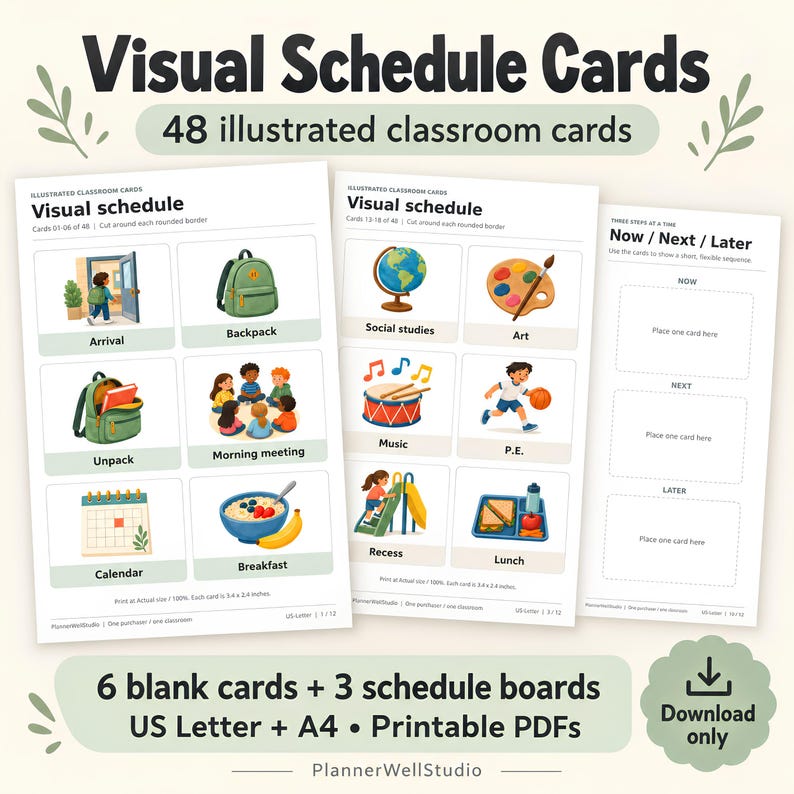
5. Visual Schedule Cards — show the day, don't just tell it
Some students cannot hold the day in their heads, and telling them the plan once is not enough. Visual Schedule Cards lay the day out in pictures, in order, where everyone can see it: first this, then this, then lunch, then this. Transitions get easier because the next step is visible before it happens, and anxiety drops because nothing is a surprise. Move the card as the day goes on so students can see progress, and change the order the night before instead of announcing a new plan in the morning. They suit any classroom with young learners, students who need routine, or a day with a lot of moving parts.
Shop the Visual Schedule Cards: Shop on Etsy
Put the system together in one week
You do not need to launch all five tools on Monday. Teach the expectations first, put the visual schedule on the wall, and hand out the jobs. Add the behavior tracker when you need a record, and keep the full pack as the place all of it lives. Classroom management is not about being strict. It is about being predictable — and a predictable room is a calmer room for everyone in it, teacher included.



0 Comments