
Progress report week should not feel like detective work. Yet for many special education teachers, that is exactly what it becomes: an evening spent digging through notebooks, sticky notes, and half-updated spreadsheets, trying to remember what a student could do in October so you can write honestly about November. The data is somewhere — you collected it, after all — but it was never reviewed, so it was never turned into a story. A monthly progress review fixes that. Done once a month, it turns your iep goal tracker from a pile of recorded sessions into a clear picture of where every student stands, while the month is still fresh enough to remember.
The review is not a second round of data collection. You already collected the data during sessions. The review is the thirty minutes, once a month, when you sit with each student's goal pages, look at the trend, and write down what changed. That short habit is what keeps progress reports from becoming a scramble, because by the time a reporting deadline arrives, the report is mostly a summary of reviews you already wrote.
Why a Monthly IEP Goal Tracker Review Changes Everything
Daily data collection answers one question: what happened today? A monthly review answers the questions that actually matter at reporting time: is this student making progress, has anything stalled, and what should change next month? Without the review, those questions get asked for the first time on the night the report is due, when there is no time left to act on the answers.
The review also catches stalled goals early. A goal that has not moved in four weeks is information, not failure — but only if you notice it in week four. A student who is flat on a reading fluency goal in November can get a new strategy, a different prompt level, or a smaller step size in December. The same student, noticed only at the annual review in March, has lost months. The monthly review is the earliest moment you can tell the difference between a slow goal and a stuck one, and early is when a change still helps.
There is a third benefit, and it is the one teachers feel most at meeting time. When a parent or administrator asks how a student is doing, a teacher who reviewed last week answers from the trend: "She went from 20 to 34 correct words per minute since September, and her accuracy held above 90 percent." A teacher who did not review answers from the last session, or from a feeling. The monthly review turns "I think she is doing better" into evidence you can point to.
Your IEP Goal Tracker Monthly Review, Step by Step
Pick a fixed day: the last Friday of the month works for most case managers, because it closes the teaching month before the next one starts. Put it on the calendar as a repeating event. Thirty minutes for a small caseload, up to an hour for a large one — and the time comes back at progress report week, with interest.
Start with the graphs, not the numbers. For each student, look at each goal's graph first. A rising line needs no analysis. A flat line needs a decision. A line that dropped needs a question: was the task harder, was the student absent, did the prompt level change? Mark each goal with one of three words: progressing, steady, or stalled. That single word per goal is the backbone of the whole review.
Next, write one sentence per goal. Not a paragraph — one sentence that a parent could understand: "Maya reads grade-level passages at 34 words per minute, up from 20 in September, and is on track for her spring target of 50." "Jonah uses his communication device independently in three out of five trials, up from one in five." These sentences are, almost word for word, what goes into the progress report later. Writing them monthly means the report is assembled, not invented.
Then decide what changes. For every stalled goal, write one change to try next month: a smaller step, more practice trials, a different material, a prompt faded one level. One change, not five — if you change everything at once, you will never know what worked. For progressing goals, write nothing except the next checkpoint: the number you expect to see at next month's review.
Finally, carry the decisions forward. The sentences and the changes go on the monthly review page for that student, in the binder, where next month's review starts. Do not leave them on a sticky note or in your head. The review page is the bridge between this month's data and next month's teaching, and it is also the first thing you open when a progress report is due.
What to Do When a Goal Has Stalled
A stalled goal deserves a closer look before it gets a new strategy. Check three things first. Was the data collected the same way all month? A change in prompt level, setting, or material can flatten a graph without the student actually stalling. Was attendance the hidden cause? Three missed weeks will stall any goal, and the fix is time, not a new program. And is the step size right? A goal written as one big jump — from 20 to 80 words per minute, say — can look stalled for months while the student is actually climbing steadily toward it. In that case the fix is a benchmark: an intermediate target that lets progress show.
If none of those explain the stall, change one thing and watch for four weeks. That is the discipline the monthly review gives you: a change, a date, and a next review to judge it by, instead of a vague plan to "work on it more."
From Monthly Reviews to Progress Reports
Here is the payoff. When progress report week arrives, you do not open the data pages and start from scratch. You open the monthly review pages — three or four of them per student, each with one sentence per goal and one decision per stalled goal — and the report writes itself from them. The sentences become the progress statements. The trend words become the ratings. The changes you already tried become the notes on next steps. What used to take an evening per student takes under an hour for the whole caseload, and it is more honest, because it was written month by month, while the teaching was still fresh.
That is the whole system: collect data where the teaching happens, review it once a month, and let the reviews carry the reporting. It is the approach behind my companion post on tracking IEP goals without a spreadsheet headache, and the same monthly rhythm I use for IEP progress reports.
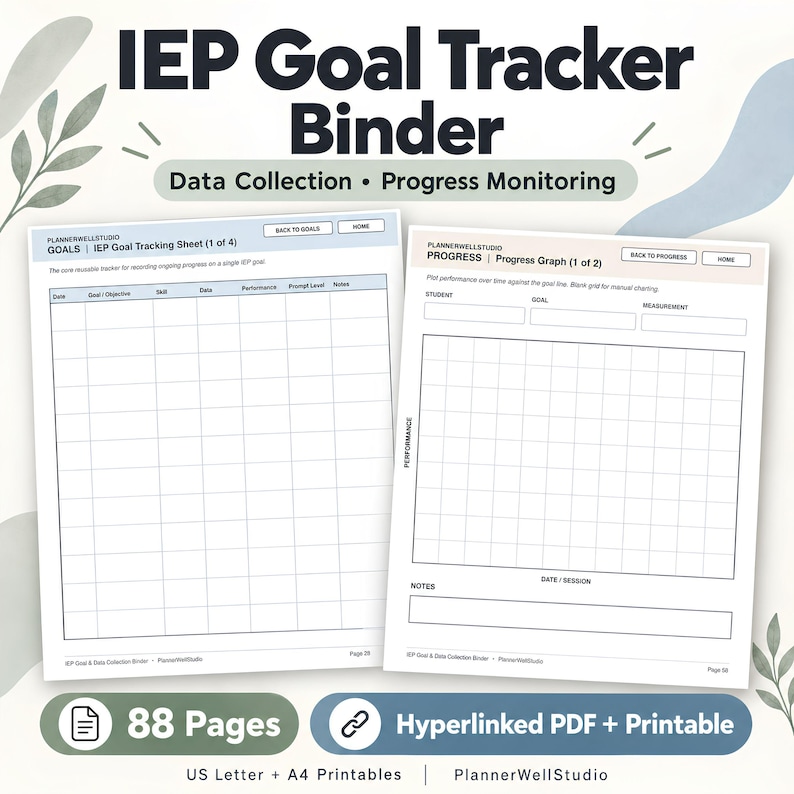
Ready-to-use help: If you want the goal sheets, data collection forms, progress graphs, monthly review pages, and caseload planning ready to use, the IEP Goal Tracking Binder is an 88-page hyperlinked PDF built for exactly this system — with printable US Letter and A4 versions included.
Browse all teacher planners here: https://www.etsy.com/shop/PlannerWellStudio
Start this month. Pick your review day, mark each goal progressing, steady, or stalled, write one sentence per goal, and decide one change for each stalled one. By the next progress report, the scramble will be gone — because the report will already be written, one month at a time.
Read next:



0 Comments