
 Speech Therapy Data Sheets: Track Every Session in Minutes

School speech-language pathologists run a schedule nobody else in the building would survive: a new student or group every twenty to thirty minutes, all day, each working on different targets. The data has to be captured inside that rhythm — because there is no quiet hour afterward in which to reconstruct six sessions from memory.
Speech therapy data sheets solve this when they are designed for speed: one sheet, one student, marks made during the session itself. Here is a setup that lets you finish each session with the data already done.
Why Speech Data Is Its Own Problem
Most classroom data systems assume one teacher, one class, and time to write. Speech therapy inverts all three. Sessions are short, groups mix students with different goals, and the clinician's hands and attention belong to the activity — the drill, the game, the conversation — not to a notebook.
So the sheet has to work at talking speed. If recording a response takes longer than the response itself, the sheet will be abandoned by the second week of school, and it deserves to be.
What a Good Speech Data Sheet Captures
For each target, four things — and only four — need to survive the session:
- The target. The sound, structure, or skill, written as you would say it to the student: "/r/ in words," "past tense -ed," "answering who questions."
- The score. Correct out of total: 7/10 says more than a page of comment, and it can be compared across weeks.
- The cue level. How much help that score took. A 7/10 independently and a 7/10 with constant modeling are different results wearing the same number.
- One short note. A word or two — "tired today," "new game worked," "struggled with /r/ blends." One line, written in the moment, that future-you will be grateful for.
Plus, Minus, and Quick Codes
The engine of the whole system is embarrassingly simple: a plus for a correct response, a minus for an incorrect one, tallied as you go. Ten trials become ten marks, counted in seconds when the session ends.
Add a tiny code set for cues, written beside the plus or minus:
- I — independent
- V — verbal cue ("listen: rrr-abbit")
- G — gesture or visual cue
- M — model given
- S — sentence or repetition support
A row like "+I +I −V +M +I" is a complete clinical picture in five characters: accuracy, independence trend, and the level of support that worked. Print the code key at the top of every sheet so a substitute clinician or a supervisor reads your data the same way you do.
One Sheet Per Student Per Week
Give each student one data sheet per week, with their current targets listed down the side and a column for each session. By Friday, the sheet shows every target, every session, and the week's accuracy at a glance — no flipping through a notebook to assemble it.
File the completed sheet in the student's section and start a fresh one Monday. When progress reports or IEP reviews come around, you have a stack of weekly sheets that turn directly into percentages and plain-language summaries: "Maya produced /r/ in words at 80% accuracy with verbal cues in 4 of 5 sessions."
From Data Sheet to Session Note in Two Minutes
Because the data was captured during the session, the note afterward is a translation, not a reconstruction:
- Read the row: total the pluses, note the main cue level.
- Write one sentence per target: the skill, the score, the support, and anything the note code flags.
- Add the plan in three words: "continue," "raise level," "new target."
Two minutes per student, done while the next group is still settling into their chairs. The clinicians who finish notes on time are not faster writers — they are the ones whose sheets did the writing during the session.
Group Sessions Without the Chaos
In groups, keep each student's sheet on its own clipboard or in its own section of a slim binder, targets facing you. Work in turns and mark as each student responds — never "catch up" on three students at once at the end, because that is where accuracy quietly dies.
One more habit helps: say the score count aloud as you mark ("that's seven out of ten") when appropriate. Students hear their own progress, stay engaged with the target, and your count stays honest.
Small Sheets, Honest Numbers
A data sheet you complete beats a detailed one you abandon. Start with plus/minus tallies and the cue codes for one week of sessions. When that rhythm holds — and it will, because it costs seconds — the rest of the system is just filing.
Keep reading
- Speech Therapy Caseload Organization for School SLPs
- ABC Data Sheets Explained: What RBTs Track Every Session
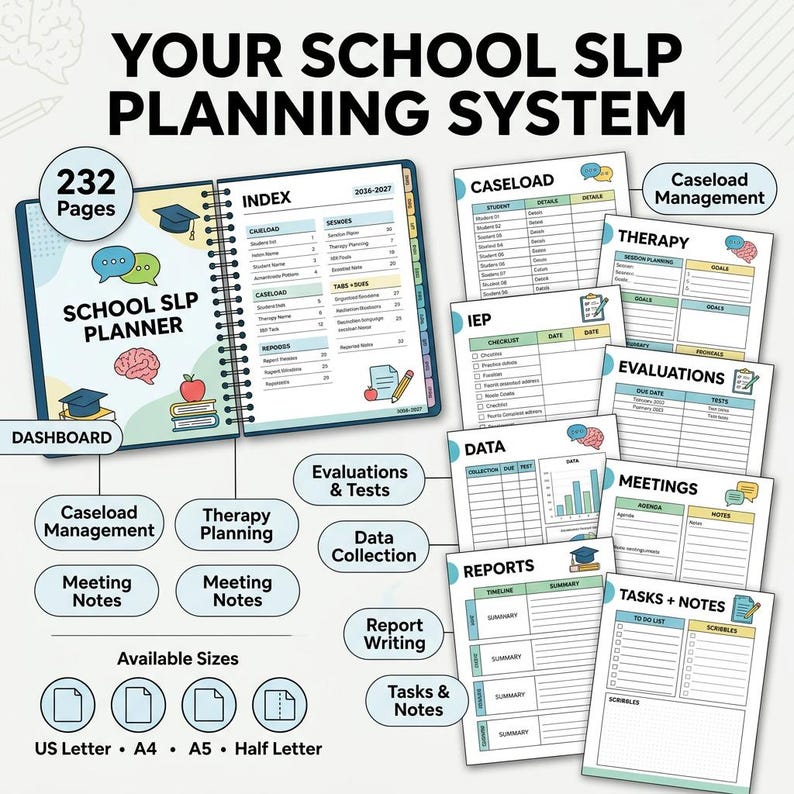
Ready-to-use help: If you want session data sheets, caseload trackers, and therapy planning pages laid out together, the School SLP Planner on Etsy was built for the back-to-back school day — data pages that match this system, ready to print.
https://www.etsy.com/listing/4556288337
Browse all speech and special education planners here: https://www.etsy.com/shop/PlannerWellStudio



0 Comments