
A school speech-language pathologist's week does not run in neat blocks. It runs in back-to-back sessions across classrooms, with a caseload list in one place, therapy plans in another, evaluation deadlines in a third, and IEP meeting dates living mostly in your head. An slp planner exists to pull all of that into one place, so the week starts with a plan instead of a hunt. When your caseload, your sessions, and your deadlines sit together, you spend the week doing therapy — not reconstructing it.
The problem is not that SLPs lack systems. It is that most systems were built for one job at a time. A calendar holds dates but not session notes. A data binder holds data but not the meeting schedule. A caseload spreadsheet holds names but not the therapy plan for each student. An slp planner built for school-based work starts from the caseload itself: who you see, when you see them, what you are working on, and what is due next.
What an SLP Planner Must Hold
A useful slp planner starts with the caseload list, not the calendar. For each student, you need the basics that shape the week: school, grade, service time, group or individual sessions, and the goals you are targeting. That one list is the map for everything else. Without it, every other page is just a form waiting for context.
Next comes the weekly therapy schedule. This is the page you will open most, so it has to show the real shape of a school week: sessions by day, groups that meet together, travel time between rooms, and the gaps where paperwork actually fits. A schedule that only lists session times is a timetable. A schedule that also shows planning blocks, make-up slots, and meeting windows is a working week.
Then the session and data pages. Speech therapy data is collected in the middle of a session, in seconds, between turns — so the page has to match the goal it serves. Trial data, accuracy notes, prompt levels, and quick session summaries all belong here, close to the caseload list they refer to. My post on How SLPs Track Caseload Data Without Losing Session Notes walks through keeping that data usable after the session ends.
The SLP Planner Weekly Routine
A planner only works if updating it is faster than avoiding it. This routine keeps a speech caseload week organized in minutes, not an evening:
- Monday morning, ten minutes: open the caseload list and the weekly schedule together. Check who is absent, which groups changed, and which sessions need a make-up slot. Note the week's meetings and evaluation deadlines before the first session starts.
- During each session: record data on that student's page as the session happens. No separate notebook, no transfer step at the end of the day when the details have already blurred.
- Friday, fifteen minutes: glance across the week's data pages. Which students moved, which stalled, and which goals need a different activity next week? Add the follow-ups — the parent message, the teacher check-in, the report draft — to next week's task list while they are fresh.
- Monthly: review the caseload as a whole. Which evaluations are coming due, which IEP meetings need preparation, and which students are ready for a goal review? A monthly sweep turns surprises into scheduled work.
Evaluations, IEP Meetings, and Reports — Without the Scramble
The busiest weeks for a school SLP are rarely the therapy weeks. They are the weeks when evaluations, IEP meetings, and reports all land at once. An slp planner earns its place in those weeks by holding the deadlines next to the caseload, not in a separate system you forget to check.
Keep an evaluation tracker with due dates, testing windows, and report status for each student. Keep a meeting page with the date, the team, and the preparation each meeting needs. Keep a reports section where drafts, due dates, and follow-ups sit together. When a deadline moves — and school deadlines always move — change it in one place, and the rest of the week still makes sense.
The same rule applies to communication. Parent messages, teacher check-ins, and team notes are easy to lose precisely because they are small. A communication log in the planner gives each one a line: who, when, about what, and what happens next. Small entries, written the same day, are what keep a caseload from quietly falling behind.
Paper, Tablet, or Both
A printed planner suits SLPs who collect data on the move and think with a pen, moving between rooms with a binder in hand. A hyperlinked PDF on a tablet suits SLPs who want the whole caseload searchable in one place during sessions and meetings, jumping from the dashboard to a student's data page in one tap. Many school SLPs run both: the tablet for daily sessions, printed pages for the file and for meetings. The format matters less than the rule behind it — one caseload, one planner, updated where the therapy happens.
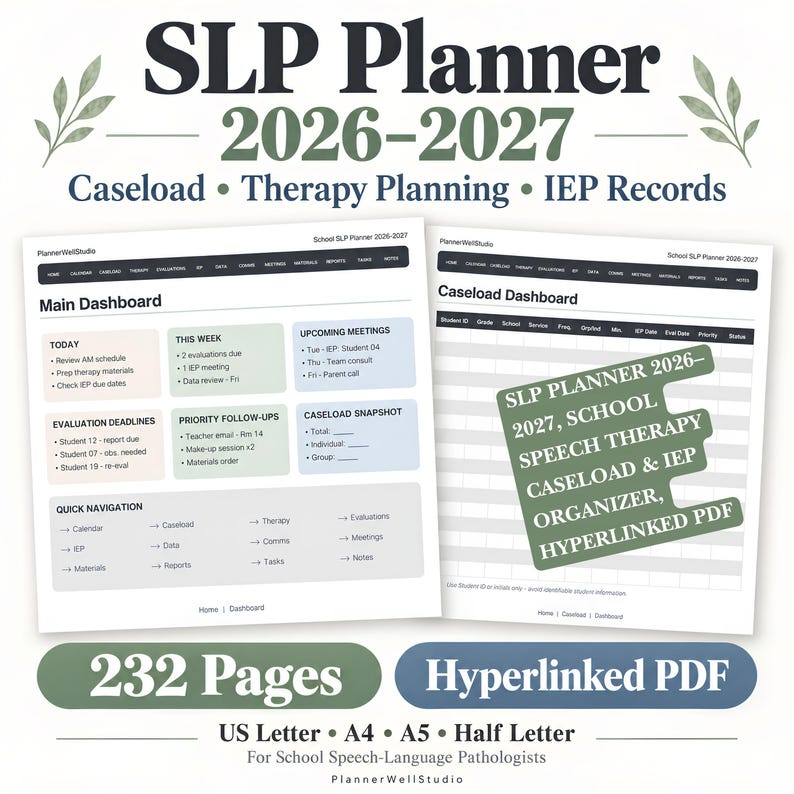
If you want that system ready-made, my School SLP Planner is a 232-page PDF planner for the 2026–2027 school year, built on exactly these sections: calendar, caseload, therapy, evaluations, IEP, data, communication, meetings, materials, reports, tasks, and notes, with a hyperlinked dashboard for quick access to each section. It comes in US Letter, A4, A5, and Half Letter sizes, so it works as a printable binder or on a tablet with a PDF annotation app.
Start With the Caseload List
Do not try to rebuild your whole system in one sitting. Start with the caseload list and the weekly schedule, fill them for this week, and run the Friday fifteen-minute review once. When next week's sessions, meetings, and deadlines are already in one place on Monday morning, you will not need convincing to move the rest of the caseload in.
Ready-to-use help: Get the School SLP Planner on Etsy — a 232-page slp planner for the 2026–2027 school year in US Letter, A4, A5, and Half Letter.
Browse all teacher planners here: https://www.etsy.com/shop/PlannerWellStudio



0 Comments