
The Back to School Student Planner and the 2026-2027 Academic Planner were made for the same busy school life, but they solve different problems. One helps a student get through each school day without losing track of homework, tests, and activities. The other helps a teacher, student, or busy family member plan the whole school year, from the first week in August to the final exams in May. Used on their own, each planner is useful. Used together, they give you a calm, clear system: a daily planner for what is due tomorrow, and a year planner for what is coming next month and next term.
That is why this guide looks at both planners side by side. You will learn who each planner is for, how to use it day by day, and how it keeps school life organized without adding another complicated routine. If you are a student who wants fewer forgotten assignments, a teacher who supports students and families, or a parent helping a child build good study habits, you will find a practical routine here that you can start this week.
Both planners are printable and fillable, so you can print the pages you need, use them on a tablet, or do a little of both. Print the daily pages for a backpack or binder, keep the monthly pages on a desk or classroom wall, and carry the weekly pages wherever school happens. The goal is not a perfect planner. The goal is a planner you actually open every day.
Back to School Student Planner: A Daily Planner Students Will Actually Use
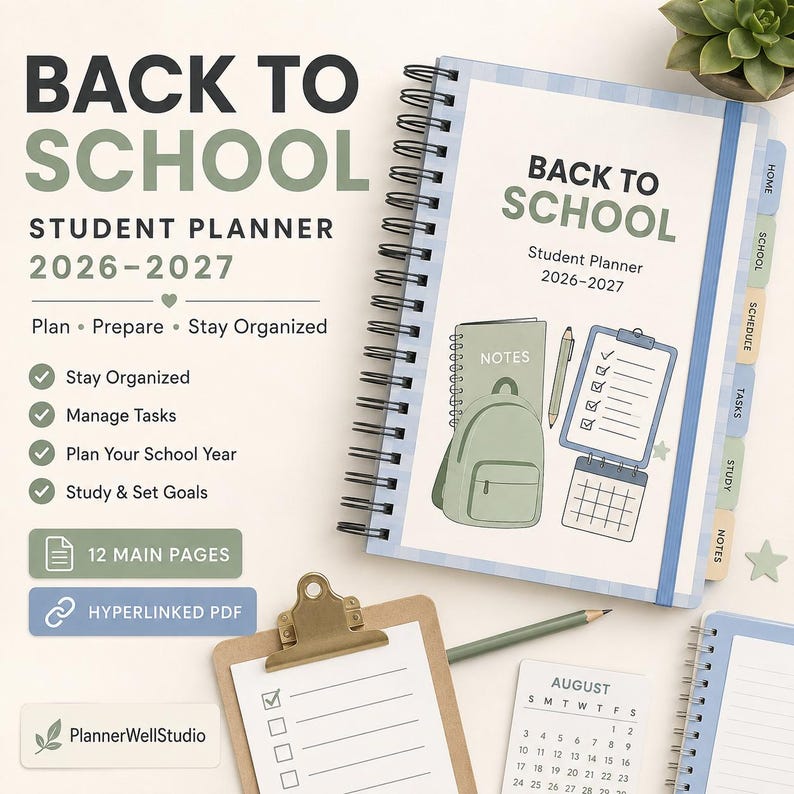
The Back to School Student Planner is for students who need a simple, friendly place to write down everything school asks them to remember. It is ideal for middle school and high school students, for college students who are still building study routines, and for younger students who are learning to manage homework with a parent or teacher beside them. Teachers can also use it to model organization for a whole class, and parents can use it to see, at a glance, what is due and what still needs attention, without having to ask the same questions every evening.
What makes this planner different is that it does not try to do everything on one crowded page. Instead, it breaks school life into small, manageable pieces: one day at a time, one subject at a time, and one task at a time. A student does not need to remember a whole system. They only need to open the planner, look at today, and do the next thing.
Who it is for
This planner is for the student who forgets a homework assignment even though they wrote it somewhere, the student who leaves studying until the night before a test, and the student who feels overwhelmed when several subjects assign work on the same day. It is also for students who are organized in one subject and scattered in another, because it gives every subject the same clear space. If a student has after-school activities, sports practice, music lessons, or a part-time job, the planner helps them see school and life together, instead of keeping them in separate heads.
For teachers, the Back to School Student Planner is a teaching tool as much as a student tool. A teacher can show students how to copy assignments accurately, how to break a large project into daily steps, and how to check off work as it is finished. For families, it turns homework time from a negotiation into a routine: open the planner, look at the list, choose the first task, and work through it together.
How to use it day by day
Start each morning, or the evening before, with a two-minute planner check. Look at today, write in any new homework, and circle the one task that matters most. That one task becomes the priority, even if other work is also due. At school, write assignments down as soon as they are given, including the subject, the due date, and any materials needed. Do not rely on memory, a photo of the board, or a message from a friend later. The planner is the single place where assignments live.
After school, use the planner as a work list. Read the list from top to bottom, estimate how long each task will take, and work in short, focused blocks. Check off each task as it is completed, and move anything unfinished to the next day with a new date, rather than leaving it floating without a plan. Before bed, spend two minutes preparing tomorrow: pack the books and materials listed in the planner, note any test or quiz, and write down one thing to remember in the morning. That evening routine prevents most morning rushes.
At the end of each week, do a ten-minute weekly review. Look back at what was completed, what was moved, and what is coming next week. Write upcoming tests, project deadlines, and activity dates into the weekly view before the week begins. This review is where the planner earns its keep: a student who reviews on Sunday rarely walks into Monday surprised. Over a month, this habit builds confidence, because the student can see progress, not just a list of things still to do.
How it keeps school life organized
The planner keeps school life organized by making the invisible visible. Homework is no longer a vague feeling that there is something to do. It is a written list with subjects, dates, and next steps. Tests are no longer surprises, because study can be spread over several days instead of crammed into one night. Projects are no longer last-minute emergencies, because large work is broken into small daily actions that fit into a normal afternoon.
It also reduces stress for the whole household. When a parent asks, what homework do you have, the student can show the planner instead of guessing. When a teacher asks whether an assignment was recorded, the student has a clear answer. When a student feels busy, the planner shows whether they are truly overloaded or simply facing three small tasks that look larger when they are kept in their head. That clarity is what turns a planner from a notebook into a study skill.
See the Back to School Student Planner on Etsy
2026-2027 Academic Planner: Plan the Whole School Year With Confidence
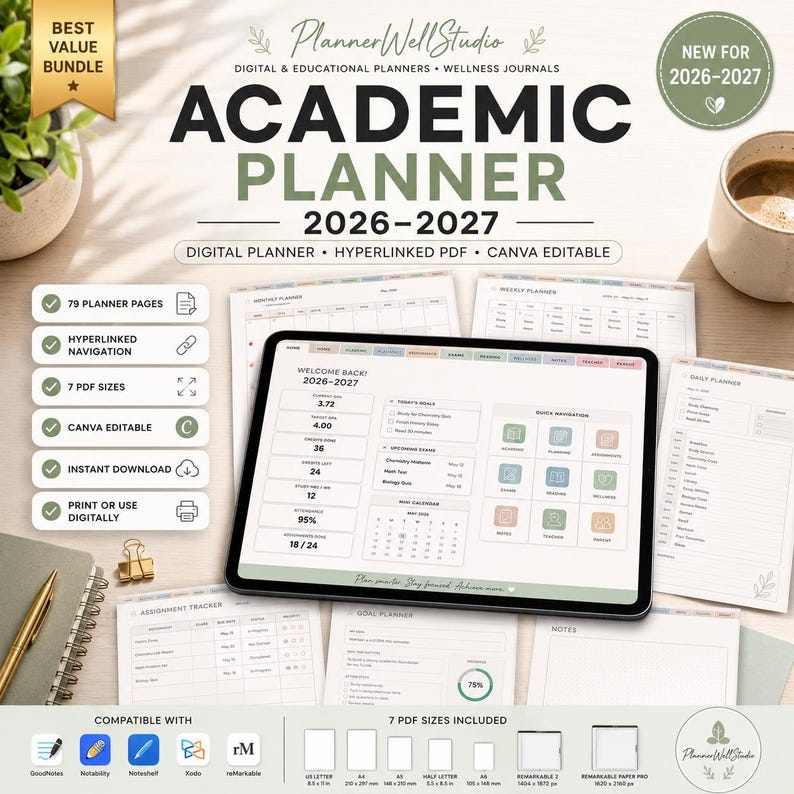
The 2026-2027 Academic Planner is for anyone who needs to see the school year as a whole, not just today. It is ideal for teachers planning lessons, units, and grading periods, for students planning a full academic year of courses and deadlines, and for families coordinating school terms, holidays, and activities across many months. It is also a strong choice for tutors, homeschool families, and school staff who juggle calendars, meetings, and long-term projects alongside daily work.
Where the student planner focuses on today, the academic planner focuses on the arc of the year. It helps you plan backward from important dates, protect time for major work, and keep term dates, breaks, and deadlines in one place. Instead of discovering a busy week when it arrives, you can see it coming and prepare for it.
Who it is for
This planner is for teachers who want a year-at-a-glance view for curriculum planning, assessment dates, parent meetings, and professional days. It is for students in a demanding year, such as a final school year or a first year of college, who need to balance several courses over two semesters. It is for parents and caregivers who coordinate more than one child, more than one school calendar, and a busy family schedule. If you have ever said, I did not realize those deadlines were in the same week, this planner is designed to prevent that moment.
It is also for anyone who likes to set goals at the start of the year and check progress along the way. A teacher can map a unit across a term, a student can plan study time around exam periods, and a family can plan holidays and activities without clashing with school commitments. The academic planner rewards a little planning up front with much less scrambling later.
How to use it day by day
Begin the year by filling in the fixed dates first: term start and end dates, holidays, exam weeks, report deadlines, and any known school events. Add personal fixed dates next, such as family commitments and regular activities. With those anchors in place, the rest of the year becomes easier to plan, because you can see the busy periods and the quieter weeks.
Each month, spend fifteen minutes on a monthly review. Look at the month ahead, note the major deadlines and events, and decide what needs preparation now rather than later. Break each major deadline into weekly steps and write those steps into the weekly pages. Each week, choose the three most important tasks for that week and protect time for them before smaller tasks fill the calendar. Each day, use the daily space to record lessons, tasks, meetings, and notes, and to carry forward anything that was not finished.
During exam periods and grading periods, the academic planner becomes a workload manager. Spread revision or marking across several days, note which days are heaviest, and leave buffer time for illness, changes, or extra help sessions. At the end of each term, review what worked, what was too crowded, and what to change next term. That short reflection turns a calendar into a professional habit that improves every term.
How it keeps school life organized
The 2026-2027 Academic Planner keeps school life organized by giving every date a home. Monthly pages prevent double-booking and reveal clashes before they become problems. Weekly pages turn monthly goals into realistic daily work. Yearly pages keep long-term goals visible when daily work threatens to take over. Together, they stop the common pattern of planning only for this week and being surprised by next month.
It also helps with communication. A teacher can share term dates and deadlines clearly, a student can show a tutor or parent exactly when major work is due, and a family can plan around school life instead of guessing. When everyone can see the same year, there are fewer missed deadlines, fewer rushed evenings, and more time for the learning itself.
See the 2026-2027 Academic Planner on Etsy
Using the Two Planners Together
Using the Back to School Student Planner and the 2026-2027 Academic Planner together is simple, and it is the system many organized students and teachers already use without naming it. Let the academic planner hold the big picture and let the student planner hold the day. On Sunday, open the academic planner, look at the month and the week ahead, and copy the important dates and deadlines into the student planner for that week. Then, each day, work only from the student planner. You do not need to check the whole year every morning. You only need to trust that Sunday planning put the right tasks into the right week.
When a new assignment, test date, or project is announced, write it in both places if it matters for the term: the student planner for the daily work, and the academic planner for the long-term view. When a week becomes overloaded, the academic planner shows you where to move work, and the student planner shows you the new daily plan. When a term ends, review both planners together: what was completed, what was learned about pacing and workload, and what to adjust for the next term. That weekly and termly rhythm is sustainable because it takes minutes, not hours, and because each planner does only one job well.
Start small. Choose one planner as your main planner for this week, add the second planner on Sunday, and keep the routine for three weeks before judging it. Most students and teachers find that the first week feels new, the second week feels easier, and by the third week the routine feels normal. School life will still be busy, but it will be busy in a planned way, with fewer surprises, fewer forgotten tasks, and more calm at the start of each day.
Ready to start? Get the Back to School Student Planner on Etsy for daily homework and study organization, and get the 2026-2027 Academic Planner on Etsy to plan the full school year with confidence.



0 Comments