
When a student's behavior is getting in the way of learning, the team does not start with a consequence. It starts with paperwork — and for good reason. The fba bip forms are the trail that turns "he acts out in math" into a testable explanation of why the behavior happens and a plan that actually changes it. FBA stands for Functional Behavior Assessment. BIP stands for Behavior Intervention Plan. The first explains the behavior; the second is the plan built on that explanation. Neither works without the other, and both live or die on the quality of the forms underneath them.
This post walks through the paperwork in order, so you can see what each form is for, what good entries look like, and where teams most often go wrong.
What FBA/BIP Forms Actually Do
An FBA is not a single form. It is a small set of forms that together answer one question: what is this behavior getting the student, or helping them avoid? Behavior is communication, and it usually serves a function — getting attention, getting access to something preferred, escaping a demand, or meeting a sensory need. Until the team knows the function, any plan is a guess. A plan that rewards a behavior meant to escape work, for example, can accidentally make the behavior stronger.
The forms force the team to slow down and collect evidence before deciding. That is their whole job. They keep the conversation factual, they make the data comparable across observers, and they give the next teacher, the next school year, and the next team a record they can actually use.
The FBA Forms, in Order
Most FBAs follow the same sequence, even when the exact form names differ by district.
1. Referral and consent. The process starts with a referral form: who raised the concern, which behavior, where and when it happens, and what has already been tried. Consent forms follow where required, because an FBA involves systematic observation and sometimes interviews. A referral that says "disruptive in class" is not usable yet. A referral that says "leaves his seat and calls out during independent math work, three to five times per lesson" gives the team something to observe.
2. Indirect assessment: interviews and rating scales. The team talks to the people who know the student best — teachers, parents, support staff — and completes structured questionnaires. These forms ask about triggers, times of day, settings, and what usually happens right after the behavior. Indirect data is fast and useful, but it is also secondhand. Treat it as a hypothesis to test, not a conclusion.
3. Direct observation: ABC data. This is where the assessment gets its backbone. Observers record the Antecedent (what happened just before), the Behavior (exactly what the student did, in observable words), and the Consequence (what happened right after). My post on ABC Data Sheets Explained shows how to write ABC entries that are actually useful — "hit the table twice and shouted no" beats "was aggressive" every time, because the second version cannot be counted, compared, or tested.
4. Frequency, duration, and scatterplot forms. ABC sheets tell you the pattern; these forms tell you the scale. How often does the behavior happen? How long does it last? At what times of day does it cluster? A scatterplot — a simple grid of days against times — often reveals a pattern nobody noticed, such as a behavior that only appears before lunch or only in one classroom. Without these numbers, the team cannot tell later whether the plan is working.
5. Data summary and hypothesis statement. The last FBA form pulls everything together into one sentence: when this happens, the student does this, in order to get or avoid that. For example: "When given a multi-step writing task, Maya tears up her paper and leaves the room, which ends the task." That sentence is the bridge to the BIP. If you cannot write it clearly, the assessment is not finished yet.
From FBA to BIP: What the Plan Forms Contain
A Behavior Intervention Plan is not a list of punishments. A good BIP form has five sections, and each one answers a different question.
Antecedent strategies: how do we prevent the behavior? These change what happens before the behavior — breaking a task into smaller steps, offering a choice, previewing a transition, seating changes, or a visual schedule. Prevention is the cheapest part of any plan and the part teams skip most often.
Teaching a replacement behavior: what do we teach instead? The student needs a skill that serves the same function and is easier than the problem behavior. If the behavior escapes a hard task, the replacement might be asking for a break with a card. The BIP form names the replacement, who will teach it, and how it will be practiced. A plan that only suppresses a behavior without teaching an alternative leaves the student with no way to get their need met.
Consequence strategies: how do we respond? This section says what adults will do when the behavior happens and, just as importantly, what they will not do. Consistency matters more than intensity here. If one adult ignores calling out and another argues with it, the student gets two different lessons, and the data becomes impossible to read.
Crisis and safety procedures, where needed. Not every BIP needs this section, but when behavior poses a safety risk, the form must state the steps, the staff involved, and how incidents are documented afterwards. This is never improvised in the moment.
Progress monitoring and review dates. The BIP form ends with the measurement plan: which forms will be used, who collects the data, how often the team reviews it, and when the plan itself is reviewed. A plan without a review date is a plan nobody owns. The same data sheets used in the FBA — ABC, frequency, duration — now become the evidence for whether the plan is working, which is why keeping them in one binder, per student, matters so much.
The Mistakes That Ruin Good FBA/BIP Forms
Three mistakes show up again and again. First, writing opinions instead of observations: "he was angry and defiant" cannot be measured, while "he threw his pencil and left the room" can. Second, collecting data for a week and then filing it: data that nobody reviews is paperwork for its own sake, and the plan drifts. Third, writing a BIP that only the specialist can follow: if the classroom teacher, the aide, and the substitute cannot each read the plan and do the same thing, it will not survive a normal school week.
The fix for all three is boring and effective: observable language, one form per behavior, and a review rhythm the team actually keeps. That is also why the forms themselves should be simple. A form with twenty boxes that nobody completes is worse than a form with five boxes that everyone completes.
A Practical Way to Keep the Paperwork Together
Start with one student and one behavior. Define the behavior in observable words, run ABC data for a week, add a frequency count, and write the hypothesis sentence before you touch the plan. Keep every form for that student in one place — referral, interviews, ABC sheets, scatterplots, the summary, and then the BIP and its review notes — so the next review starts from the last one instead of from scratch. My post on Behavior Data Collection: Simple Sheets That Capture What Matters covers the frequency and duration forms in more detail.
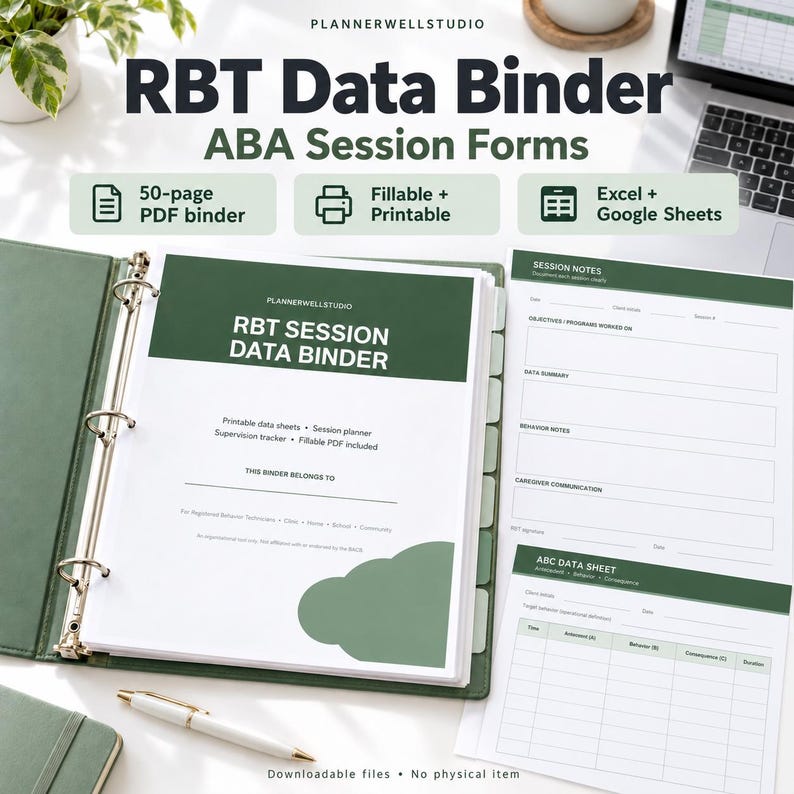
Ready-to-use help: If you want the ABC data sheets, frequency and duration forms, session note pages, skill acquisition trackers, and supervision logs already laid out and ready to print, the RBT / ABA Session Data Binder was built for exactly this kind of data collection — one clear sheet per behavior, per session, so the FBA and the BIP both rest on real numbers.
Browse all teacher planners here: https://www.etsy.com/shop/PlannerWellStudio
Start with the definition. Write the behavior in words anyone could observe and count, collect a week of honest ABC data, and let the forms do their job: turning a difficult behavior into a clear explanation, and a clear explanation into a plan the whole team can follow.
Read next
ABC Data Sheets Explained: What RBTs Track Every Session
Behavior Data Collection: Simple Sheets That Capture What Matters



0 Comments