
The College Assignment Planner and the Back to School Student Planner were made for the same busy reality: school life does not wait for a quiet week. Classes overlap, deadlines move, study sessions get squeezed between work and family life, and a single missed date can turn a manageable week into a stressful one. A good planner does not add more work. It gives every task a home, every deadline a visible date, and every student a calmer way to start the day. That is why these two planners from PlannerWellStudio work so well together. One is focused and detailed for college coursework. The other is broad and welcoming for the whole school year. Used alone, either one can change how a student plans. Used together, they cover both the big picture and the daily detail.
Many students do not fail because they lack ability. They struggle because their plans live in too many places: a note in a phone, a screenshot of a syllabus, a message from a classmate, and a memory that was never written down. When information is scattered, it is easy to double-book study time, forget a small assignment worth important marks, or discover an exam only a day before it happens. A planner solves that problem by becoming the one trusted place to check. Open it in the morning, and the day is already mapped. Open it in the evening, and tomorrow is already prepared. That simple habit, repeated daily, builds confidence and protects grades, sleep, and free time.
In this guide, you will meet both planners in detail. You will learn who each planner is for, how to use it day by day, and how it keeps school life organized from the first week of term through exams and final projects. You will also see how to choose between them, how to use them together if you need both, and how to build a short daily routine that takes only a few minutes. Whether you are a college student juggling several courses, a school student starting a new year, a parent helping a teenager get organized, or a teacher recommending a practical tool, this article will help you find the right starting point.
1. College Assignment Planner
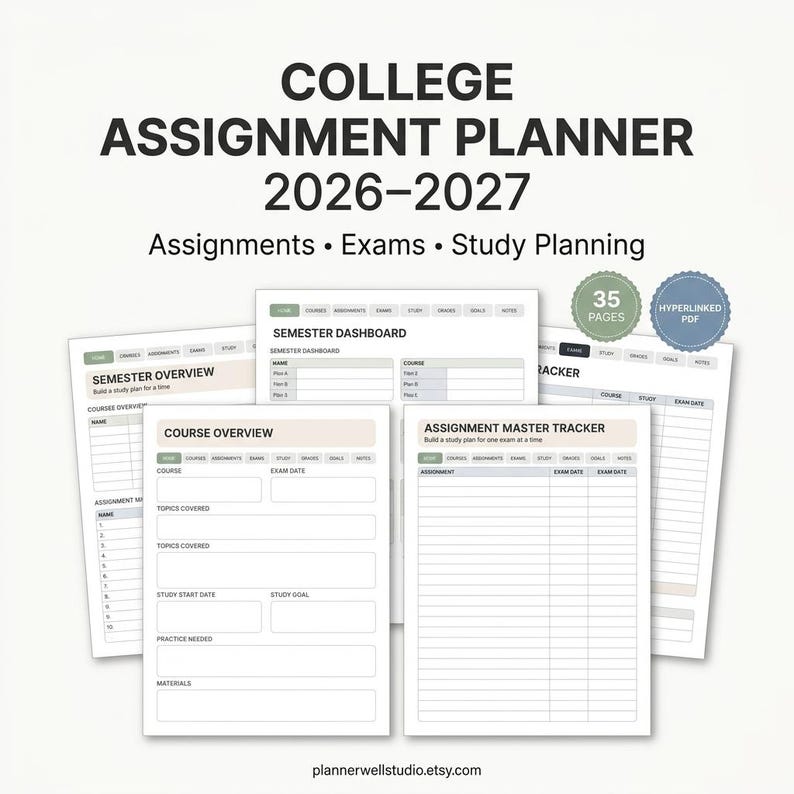
See the College Assignment Planner on Etsy here: College Assignment Planner.-
-
Who the College Assignment Planner is for
The College Assignment Planner is for college and university students who carry several courses at once and need to track assignments, exams, study sessions, grades, and projects without losing the thread. It is ideal for first-year students who are learning how to manage their own schedules for the first time, for returning students who want a cleaner system than scattered notes, and for busy students who also work part-time, care for family, or take part in clubs and sports. If you have ever said, I thought that assignment was due next week, this planner was designed for you.
It is also a strong choice for students in demanding programs where small tasks add up quickly: weekly readings, lab reports, essays, presentations, group work, and revision all compete for the same hours. Teachers, tutors, and academic coaches can recommend it to students who need structure without complexity. The planner is a digital download, so it can be used on a tablet with a note-taking app or printed for a paper binder. That flexibility matters, because some students think best with a stylus and searchable pages, while others remember better when they write by hand.
How to use the College Assignment Planner day by day
Start each semester by completing the semester overview and course overview pages. Write every course name, instructor, class time, and grading rule in one place. Then transfer every due date from every syllabus into the assignment master tracker. Do not wait for the first busy week to do this. A complete tracker at the start of term is the single most powerful step, because it shows clashes early, when you can still plan around them.
Each Sunday, spend fifteen minutes planning the week ahead. Look at the assignment tracker, note what is due in the next seven days, and break larger tasks into smaller steps. An essay due on Friday becomes research on Monday, an outline on Tuesday, a draft on Wednesday, and editing on Thursday. A revision plan for an exam becomes short daily sessions instead of one exhausting night before the test. Write those steps into your daily pages, not just the final deadline. Progress feels easier when the next step is small and clear.
Each morning, open the planner for two minutes. Check classes, assignments due today, and study blocks. Put the most important task first, before messages and social media pull your attention away. During the day, tick off tasks as you finish them and note any new dates immediately, even if you are between lectures. In the evening, spend five minutes reviewing what is done, moving unfinished work to a realistic new date, and preparing tomorrow. That evening review is what stops work from silently piling up.
Use the study planning pages to protect revision time. Schedule study sessions like appointments, choose one subject per session when possible, and write a clear goal for each session, such as complete ten practice questions or summarize two chapters. Use the exam planning pages to list exam dates, topics to revise, materials needed, and practice scores. When grades arrive, record them promptly. Seeing progress over the semester helps you decide where to spend extra effort and where you are already secure.
How the College Assignment Planner keeps school life organized
Organization comes from visibility. When every assignment, exam, and study session is visible in one system, you no longer need to rely on memory or search through messages. The semester dashboard gives a wide view, the assignment tracker gives control over details, and the daily and weekly pages turn big goals into action. Hyperlinked pages make it fast to jump between sections on a tablet, so planning does not become a chore in itself.
The planner also reduces stress by making work finite. A long list in your head feels endless. The same list, broken into dated steps in a planner, feels doable. You can see what must happen today, what can wait until tomorrow, and what is already finished. That clarity helps with sleep, because the brain can let go of tasks that are safely written down. It also helps with communication, because you can tell a teacher, tutor, or group partner exactly where a project stands.
For group projects, use the planner to record who is doing what and by when. For long-term projects, add milestones for research, drafts, feedback, and final checks. For reading-heavy courses, track chapters completed and questions to ask in class. Small, consistent records prevent last-minute surprises and make it easier to ask for help early, when help is most useful. Over a semester, these habits build a record of your own working style, so each term becomes easier than the last.
2. Back to School Student Planner
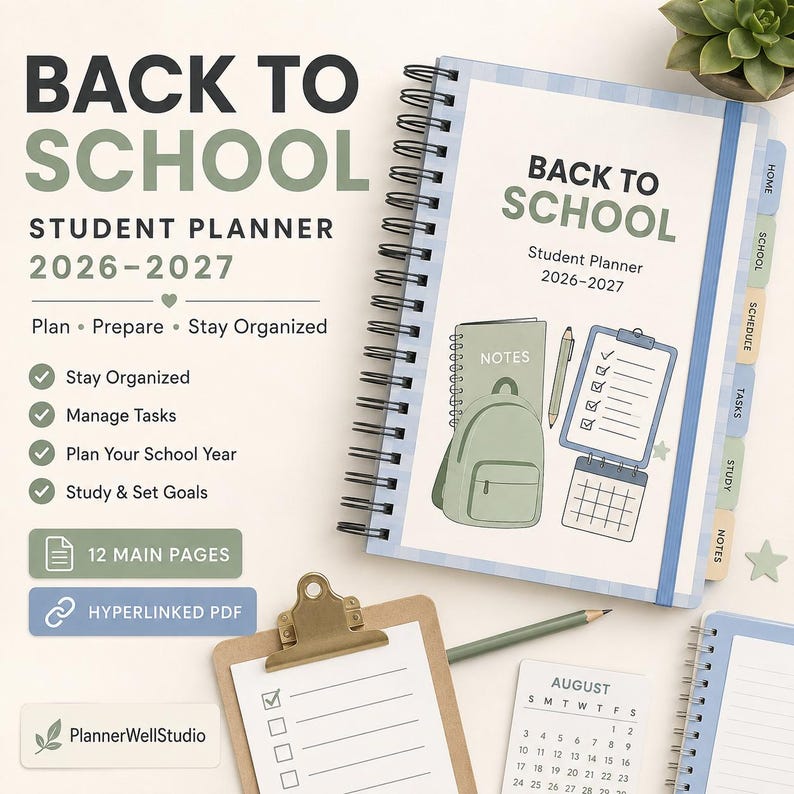
See the Back to School Student Planner on Etsy here: Back to School Student Planner.-
-Who the Back to School Student Planner is for
The Back to School Student Planner is for school students who want a fresh, friendly start to the school year and a simple system for schedules, tasks, study, goals, and important dates. It is perfect for students moving to a new school, starting a new grade, or returning after the summer break and wanting to feel prepared rather than rushed. Parents can use it with younger students to build independence step by step, while older students can use it on their own as a daily companion for homework, revision, and activities.
It is also useful for students who feel overwhelmed by a new timetable, new teachers, and new expectations all at once. Instead of trying to remember everything, they can write it down in a planner that is easy to open and easy to understand. Teachers can recommend it at the start of term as a classroom organization tool, and families can use it to keep school, homework, clubs, sports, and appointments in one shared routine. The planner is a hyperlinked digital PDF and printable, so it works on a tablet or on paper, depending on what the student prefers.
How to use the Back to School Student Planner day by day
Begin the school year by filling in your class schedule, important dates, and goals. Write down what a successful term looks like for you, not only in grades but in habits: reading every evening, handing work in on time, asking questions in class, or joining one activity you enjoy. Goals become real when they are written down and reviewed, so return to them at the start of each month and note one small improvement.
Each evening, prepare for the next school day. Pack what you need, check homework, and write the next day's tasks in the planner. This short routine prevents morning rush and forgotten books. Each morning, glance at your schedule and tasks before you leave home. Knowing what is coming makes the day feel more predictable, even when lessons are challenging. During school, note homework and deadlines as soon as teachers give them, rather than trusting memory until you get home.
After school, use the planner to plan homework in short, focused blocks. Start with the hardest or most urgent task, take a short break, then continue with the next task. Tick off completed work so progress is visible. Use study pages to plan revision in small steps across the week, instead of leaving everything for the night before a test. At the end of the week, review what went well, what was missed, and what needs extra attention next week. That weekly review turns a planner from a notebook into a learning tool.
Use the planner for life beyond homework as well. Record club meetings, sports practice, music lessons, family plans, and school events. When everything is in one place, it is easier to balance study with rest and fun. A student who can see a busy week coming can plan rest time in advance, ask for help early, and avoid the feeling that school is taking over every hour. Balance is not about doing less; it is about choosing when to do each thing.
How the Back to School Student Planner keeps school life organized
The Back to School Student Planner keeps school life organized by giving the whole year a clear shape. The school year stops feeling like a blur of unrelated days and becomes a sequence of weeks, goals, and milestones. Schedules show where you need to be, task pages show what you need to do, and study pages show how you will prepare. Important dates are no longer hidden in letters, emails, or announcements; they live in the planner you check every day.
It also supports good habits. Writing tasks down, checking them off, and reviewing the week teaches responsibility in a gentle, practical way. Students learn to estimate how long work takes, to start earlier when a task is large, and to break work into steps they can actually finish. These are skills that help far beyond one school year. They help with exams, projects, part-time work, and later study, because organized students can focus on learning instead of searching for lost instructions.
For families, the planner creates a calm conversation about school. Instead of asking, did you do your homework, a parent can ask, what is in your planner today, and look together at what is planned, what is done, and what needs support. For teachers, a student who arrives with a planner is a student who can answer questions about deadlines, revision, and next steps. That confidence shows in class, in homework quality, and in the way students handle setbacks, because a missed task becomes a plan to catch up rather than a reason to give up.
How to choose, and how to use both planners together
If your main challenge is college coursework with many assignments and exams, start with the College Assignment Planner. Its detailed tracker, semester dashboard, and exam planning pages are built for that level of detail. If your main need is a clear, friendly system for the whole school year, start with the Back to School Student Planner. Its schedule, task, study, and goal pages cover daily school life without feeling complicated.
Some students benefit from both. For example, a college student can use the Back to School Student Planner for the overall year, routines, and personal goals, and the College Assignment Planner for detailed coursework, assignment tracking, and exam preparation. A school student moving toward college can start with the Back to School Student Planner and grow into the College Assignment Planner as coursework becomes more complex. The key is to keep one planner as the main daily check, so tasks are never split across two systems in a confusing way. Use the second planner for its special strength, and review both in your weekly planning session.
Whichever planner you choose, keep the routine simple. Plan on Sunday, check each morning, record tasks immediately, review each evening, and celebrate finished work. Keep the planner where you will actually see it: on your tablet home screen, in your school bag, or on your desk. If a week goes wrong, do not abandon the system. Open the planner, move unfinished tasks to realistic dates, and start again the next morning. Organization is not about perfect weeks. It is about returning to the plan, again and again, until it becomes a habit.
The College Assignment Planner and the Back to School Student Planner share one simple promise: school life feels lighter when it is written down, planned in small steps, and reviewed regularly. They help students protect their time, meet deadlines with less stress, and build confidence that grows with every completed week. Start with the planner that matches your school life today, build a five-minute daily habit, and let the planner carry the details so you can focus on learning, creating, and enjoying the school year ahead.
Read next
- Special Education Teacher Planner and College Assignment Planner: Two Planners That Keep School Life Organized
- Back to School Student Planner and 2026-2027 Academic Planner: Two Planners That Keep School Life Organized



0 Comments