
Most people can tell you what they earn. Far fewer can tell you what they are worth. That is the gap a net worth tracker printable closes. Net worth is a single subtraction — everything you own minus everything you owe — and it is the one number that tells the truth about your money, because income alone never does. A teacher on a steady salary with no debt can be worth more than a high earner paying off three loans, and the only way to know which side of that line you are on is to write both lists down and do the maths.
Students need this lesson even more than adults do. Personal finance is rarely taught as a skill with a worksheet, so young people leave school knowing how to earn and spend, and never learning how to measure where they stand. A net worth tracker turns an abstract idea into a page they can fill in: list what you own, list what you owe, subtract, and write the date. It takes twenty minutes the first time and ten minutes every quarter after that, and it is one of the most useful habits a student can carry out of school.
What a Net Worth Tracker Actually Measures
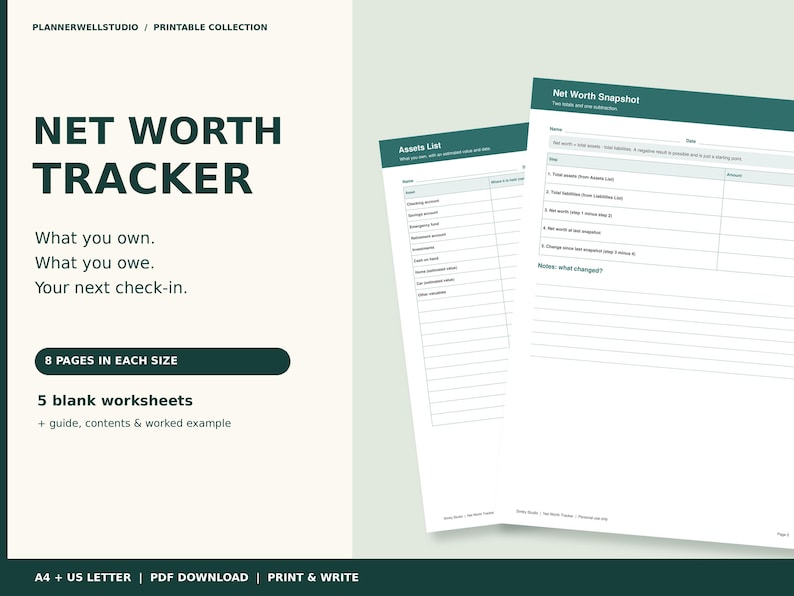
A net worth tracker measures two lists and one subtraction. The assets list is everything you own that has a value: bank accounts, savings, a retirement account, investments, cash, a car, a home. The liabilities list is everything you owe: credit cards, car loans, student loans, a mortgage, personal loans, unpaid bills. Add up each list, subtract the second total from the first, and the answer is your net worth on that date.
The date matters as much as the number. Net worth is a snapshot of a moment, not a verdict on a life. It goes up and down as debts are paid off, savings grow, and the value of things changes. That is why the tracker has a quarterly page: the same calculation repeated every three months turns one number into a direction, and the direction is what you are really tracking.
The pages in this tracker are printed and filled in by hand. There are no formulas and nothing to type: you write the amounts, add them up with a calculator, and copy the totals onto the snapshot page. That slowness is deliberate. Writing each item by hand forces you to look at it, and looking at it is the point — a forgotten loan is still a loan, and a savings account you never check is still yours.
Why Net Worth Matters More Than Income
Income is a flow and net worth is a stock, and confusing the two is the most common money mistake there is. A pay rise feels like progress, but if the extra money goes straight out on a bigger car loan, net worth has not moved. A student who earns a little from a part-time job and owes nothing can have a higher net worth than a graduate on a good salary with a student loan and two credit cards. The salary tells you what comes in. Net worth tells you what stays.
This is also why net worth is a kinder number than income for a classroom conversation. Nobody has to share a salary, and nobody's number is a judgement. A negative net worth early in life is normal — a student loan is an investment that has not paid off yet — and it is only a starting point. What matters is whether the number moves in the right direction quarter by quarter, and whether the person holding the pen understands why.
For teachers, the same page works as a household tool. A teacher's finances are usually a mix of a steady salary, a pension or retirement account, a mortgage or rent, and the small debts that accumulate quietly — a card balance, a car payment, a loan taken out years ago and half forgotten. Putting all of it on one page, once a quarter, takes the background worry out of money and turns it into a list with a plan attached.
How to Work Out Your Net Worth in Four Steps
The calculation is simple. The discipline is in writing everything down honestly.
Step 1: list your assets. Go through the assets list page and write down everything you own with a value. Bank accounts and savings at their current balance. A retirement account at its latest statement value. Investments at what they are worth today. A car at a realistic estimate, with the date written beside it, because a car's value changes. A home at a realistic estimate, not the price you paid for it years ago. Cash you hold. Anything you leave off the list is invisible to the calculation, so be thorough — and use estimates where an exact figure does not exist.
Step 2: list your liabilities. On the liabilities page, write down everything you owe, at the current balance, not the original amount. Credit cards, car loans, student loans, a mortgage, personal loans, unpaid bills. The current balance is the number that matters: a loan you took out for 10,000 and have paid down to 3,800 is a 3,800 liability today, and the tracker should show today's truth, not the history.
Step 3: subtract. On the Net Worth Snapshot page, copy the two totals and subtract: total assets minus total liabilities. That is your net worth. Write the date beside it. A positive number means you own more than you owe. A negative number means you owe more than you own — and if that is the case, the number is information, not a failure. It tells you exactly how far there is to go, and the next quarter's snapshot will show whether you are closing the gap.
Step 4: repeat every quarter. Copy each snapshot onto the Quarterly Tracker: date, assets, liabilities, net worth, and one line on what changed. The change from one quarter to the next matters more than any single number. A small rise every quarter, repeated for a year, is real progress — and it is the kind of progress that only shows up when you measure it.
A Worked Example (Fictional Numbers)
A worked example makes the subtraction concrete. These are fictional numbers from the example page in the pack — nobody's real accounts, just a clear illustration of how the maths works.
Assets: savings 4,200 + checking 1,350 + retirement 18,500 + car (estimated) 6,000 = 30,050.
Liabilities: credit card 1,200 + car loan 3,800 + student loan 9,500 = 14,500.
Net worth: 30,050 − 14,500 = 15,550.
That is the whole calculation. Notice what it does not contain: no salary, no monthly spending, no budget categories. Net worth does not care how much you earn in a month. It cares what you have kept and what you still owe, and that is why it is the number worth tracking.
In a classroom, this example is the safe way to teach the idea. Students work with fictional numbers first — the example in the pack, or numbers they invent together — so they learn the method without sharing anything real about their own families. Once they can do it with invented figures, they can do it privately at home with their own.
The Quarterly Habit That Makes It Useful
A net worth tracker only works if someone looks at it more than once. The habit that makes it stick is a short quarterly check-in: the same day each quarter, open the tracker, update the two lists, do the subtraction, and copy the new totals onto the Quarterly Tracker. Ten minutes, four times a year.
The quarterly page is where the story appears. One snapshot is a fact; four snapshots are a trend. Did assets grow because savings went up, or because a retirement account rose? Did liabilities fall because a loan was paid down, or rise because a card balance grew? The "what changed" line on the tracker forces that question, and the answer is usually the most useful part of the exercise — it shows which habit is moving the number, and which one is holding it back.
The Goals & Review page, used once a year, closes the loop. Look at the four quarters together, pick one thing to improve next year — pay down one debt, build one savings buffer, stop one leak — and write it down. A goal written on the same page as the numbers is far more likely to survive January than a resolution made without them.
Teaching Net Worth in the Classroom
For teachers who want to bring this into a lesson, a net worth tracker is a ready-made life-skills activity for older students. It needs no preparation beyond the printed pages and the fictional example, and it teaches four things at once: what an asset is, what a liability is, how subtraction becomes a decision, and why a number measured over time beats a number guessed once.
Keep the activity private by design. Students should never be asked to share their family's real finances, or even their own. Work with the fictional example as a class, let each student practise with invented numbers, and send the blank pages home for anyone who wants to try it with their own figures in private. The skill is the method, and the method transfers without anyone revealing anything.
It also pairs naturally with the other money skills students are already learning — budgeting, saving, understanding interest. A budget tells you where money goes in a month. A net worth tracker tells you whether the month left you better off. Taught together, they give students both the short view and the long one.
The Mistakes a Net Worth Tracker Prevents
The mistakes are quiet ones. The savings account forgotten about for two years, so it never counted. The old loan balance remembered at its original amount, so the debt looked bigger than it is. The car valued at what it cost new, so the assets looked better than they are. The snapshot taken once, never repeated, so there was no way to know whether things were improving.
None of these need a finance degree to fix. They need a page, a pen, and a date. A net worth tracker is the cheapest fix there is: eight pages, a calculator, and ten minutes a quarter. It does not give financial advice, and it is not a substitute for it — these are personal organizing tools, not financial, investment, tax or legal advice. What it guarantees is that the number you are working with is a real one, measured the same way every time, so the decisions you make from it are based on something solid.
Ready-to-use help: If you want the full tracker ready to print, the Net Worth Tracker Printable was built for exactly this habit — an 8-page printable PDF in A4 and US Letter, with an assets list, liabilities list, net worth snapshot, quarterly tracker, goals and review page, and a filled example page. The same tracker is also on Payhip here: https://payhip.com/b/Hqmht and on Gumroad here: https://durakhshanirfan.gumroad.com/l/net-worth-tracker-printable
Keep your information safe: write account names, not full account numbers, and never share your tracker pages with anyone. These are personal organizing tools, not financial advice.
Browse all teacher planners here: https://www.etsy.com/shop/PlannerWellStudio
Start this quarter. List what you own, list what you owe, subtract, and write the date. Three months from now, do it again — and watch the number move.



0 Comments