
Today's post is for the school professionals who carry a full caseload, a full calendar, and a long list of follow-ups in their heads. The School SLP Planner and the Special Education Teacher Planner were both made to take that mental load and turn it into one calm, organized system. In this post, you will see both planners in action, learn who each one is for, and find a simple day-by-day way to use them so school life stays organized from the first bell to the last note.
Both planners are hyperlinked digital planners, which means you can tap a tab or a section heading and jump straight to the page you need. You do not have to flip through a whole binder to find one student, one meeting, or one data sheet. That small change saves minutes every day, and those minutes add up across a school year.
A good planner does more than hold dates. It helps you prepare, remember, follow up, and show your work when it matters. That is true whether you are planning speech therapy sessions for many students or coordinating lessons, accommodations, and IEP goals for a whole class. The two planners below share that goal, but each one is built around a different kind of school day.
School SLP Planner: Built for Speech-Language Pathologists
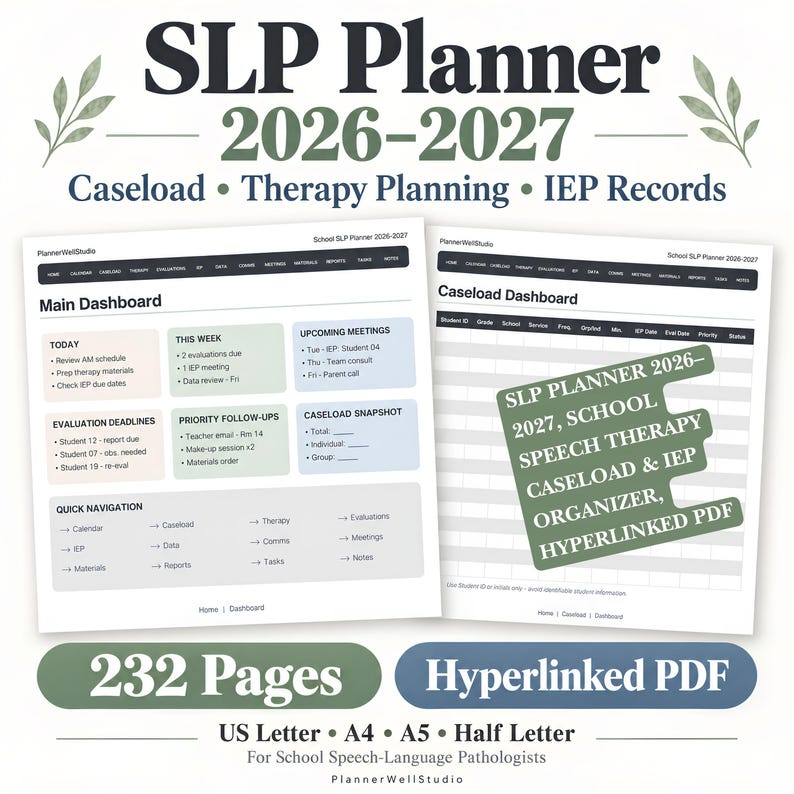
Watch the School SLP Planner in action in the video below.
Who it is for. The School SLP Planner is for school-based speech-language pathologists who manage a caseload across grades, schools, or service models. If you see students individually, in small groups, and in classrooms, and you also track evaluations, meetings, and parent communication, this planner is designed around that exact workload. It is also helpful for SLPs who are new to a school and need a clear place to record caseload details without starting from a blank notebook.
How to use it day by day. Start the morning by opening the main dashboard and checking today's sessions, upcoming meetings, and priority follow-ups. That one glance tells you where you need to be, who you need to see, and what still needs attention. During the day, use the caseload pages to keep student details, goals, and service minutes in one place, and use session notes right after each session while the details are fresh. At the end of the day, spend five minutes updating progress, noting which students need materials prepared, and checking tomorrow's schedule. That short closing routine prevents the Monday-morning scramble and keeps data from piling up.
How it keeps school life organized. The planner keeps caseload planning, therapy planning, and IEP records together, so you are not searching across separate folders, sticky notes, and spreadsheets. Evaluation deadlines, priority follow-ups, and a caseload snapshot sit where you can see them, which makes it easier to prepare for meetings and to answer questions from teachers and families. Because it is hyperlinked, you can move from a dashboard to a student page to a meeting page in seconds, and you can return to the same structure every week without rebuilding it.
Over a week, the pattern becomes simple: plan on Monday, track as you go, review on Friday, and carry only the open items forward. Over a term, that pattern becomes a record you can trust, with session notes, progress notes, and meeting notes in a consistent place. If you want to see the full planner, you can find the School SLP Planner on Etsy here: School SLP Planner on Etsy.
Special Education Teacher Planner: Built for Special Education Teachers
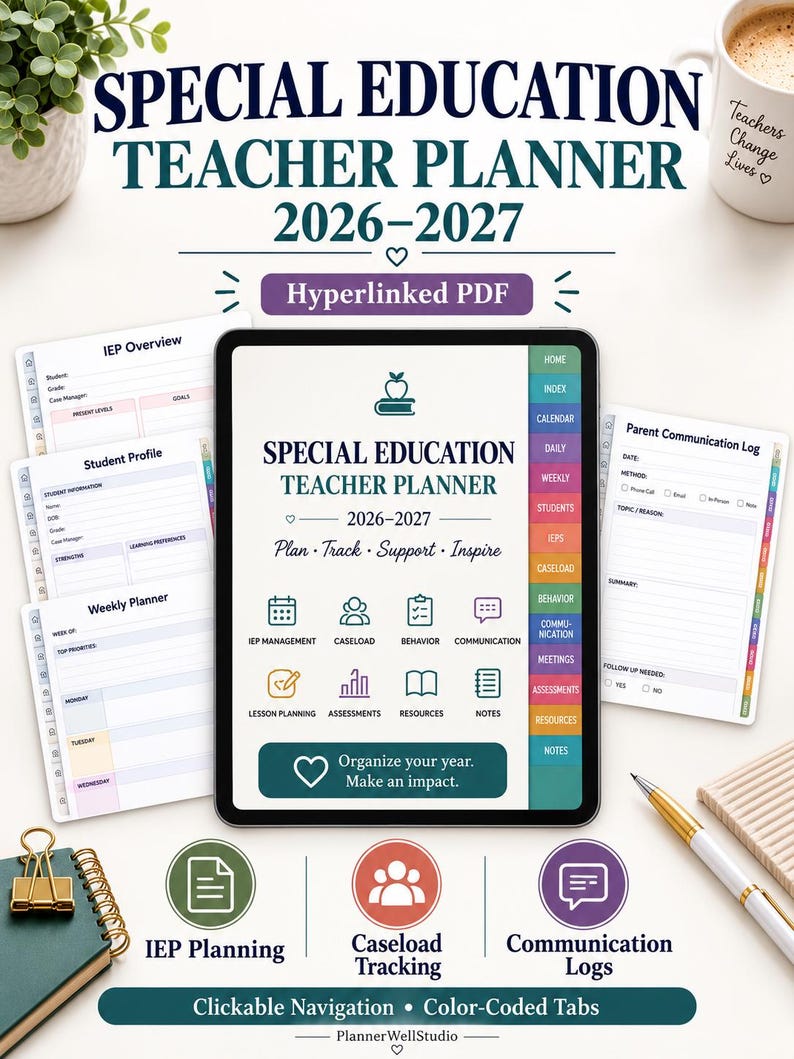
Watch the Special Education Teacher Planner in action in the video below.
Who it is for. The Special Education Teacher Planner is for special education teachers who balance lesson planning, IEP work, behavior documentation, meetings, accommodations, and parent communication every day. It is for teachers who support students with different needs, goals, and schedules, and who need one place to hold all of that without losing the details. It is also useful for teachers who co-teach, work with paraprofessionals, or coordinate with related service providers, because it keeps shared information organized and easy to find.
How to use it day by day. Begin the day with a quick review of lessons, student needs, and any meetings or check-ins. Use the color-coded tabs to jump to IEP planning, caseload tracking, or communication logs without hunting through pages. During lessons, keep notes on what worked, which students need extra support, and which accommodations were used, so that information is ready when you plan the next lesson. After school, update IEP goals, record parent communication, and set up the next day's materials. That end-of-day check is short, but it means you leave school with a clear plan instead of a long list in your head.
How it keeps school life organized. This planner brings IEPs, caseloads, behavior documentation, meetings, accommodations, parent communication, lesson planning, and daily organization together in one easy-to-use PDF. Instead of keeping a separate notebook for each area, you can follow the same tabs and the same weekly rhythm. That consistency helps on busy days, on weeks with many meetings, and on days when a substitute or a colleague needs to find information quickly. It also helps at progress-report time, because goals, notes, and communication are already grouped in a way that makes reporting faster and more accurate.
Across a school year, the planner supports a steady routine: set goals, plan lessons around them, track progress, communicate with families, and review what needs to change. Teachers can adapt the same structure to different grade levels and caseloads, and they can keep the focus on students rather than on paperwork. If you want to see the full planner, you can find the Special Education Teacher Planner on Etsy here: Special Education Teacher Planner on Etsy.
Choosing the Planner That Fits Your School Day
If your day is centered on speech therapy sessions, caseload data, and IEP records for speech and language, start with the School SLP Planner. If your day is centered on classroom lessons, IEP caseload tracking, behavior notes, and coordination across a special education program, start with the Special Education Teacher Planner. Some schools will use both, with SLPs and special education teachers each working from a planner built for their role while sharing the same organized approach.
Whichever planner you choose, the best system is the one you will actually open every day. Keep it in one place, check it in the morning, update it right after sessions or lessons, and review it at the end of the week. Small, regular habits matter more than a perfect setup, and a planner that is easy to navigate makes those habits much easier to keep.
Both planners are available from PlannerWellStudio on Etsy, and both are designed to help school professionals spend less time searching for information and more time supporting students. Watch the videos above, look at the cover pages, and choose the planner that matches the work you do most. A more organized school day starts with one clear page, one clear plan, and one system you can trust.



0 Comments