
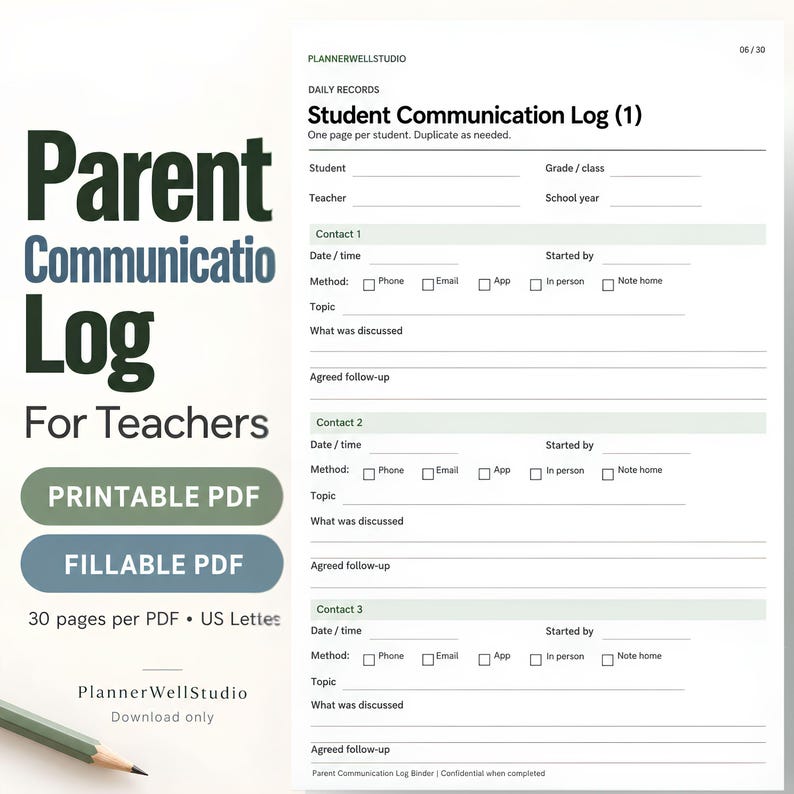
A parent communication log is easy to keep for a week and hard to keep for a year. The daily entries are not the problem — most teachers can write a line after a call or an email. The problem is what happens to those entries afterward. They sit in the binder, page after page, and nobody ever looks back at them until a conference arrives or a question comes up, and then the teacher is flipping through weeks of notes trying to reconstruct what happened with one family. A parent communication log earns its keep not when you write in it, but when you can read back from it in thirty seconds. That is what the monthly summary habit is for.
The habit is simple: once a month, on a fixed day, you spend fifteen minutes turning that month's entries into one summary page per class — or one short section per student for the families you contacted most. Not a rewrite of every entry. A summary: who you contacted, about what, what was agreed, and what is still open. Done monthly, it keeps the log useful all year instead of letting it turn into an archive you never open.
Why Your Parent Communication Log Needs a Monthly Summary
Daily entries capture facts. A monthly summary captures patterns, and patterns are what change your teaching and your family relationships.
First, the summary shows you who you have not contacted. Scan a month of entries and the gaps jump out: the quiet family you meant to call, the student whose only contact was a behavior note, the parent who always initiates and never hears from you first. A parent communication log that only records the conversations that happened cannot show you the ones that did not — but a monthly summary can, because the blank space next to a name is visible in a way that a missing page in a binder never is.
Second, the summary turns scattered notes into a story you can use. At conference time, instead of re-reading six weeks of entries, you read three monthly summaries and you already know the arc: the reading concern raised in September, the strategy agreed in October, the progress noted in November. You walk into the conference with the history in your head, not in a stack of pages.
Third, it closes the loop on follow-ups. Every entry that ends with "I will check Friday" or "call back Monday" either happened or it did not. The monthly summary is where you check. Open follow-ups get carried forward to next month's page, not lost between entries. That single step — carrying forward what is still open — is the difference between a log that records promises and a log that keeps them.
How to Write the Monthly Summary in Fifteen Minutes
Pick a fixed day: the last Friday of the month works for most teachers, because it sits naturally at the end of a teaching week. Put it on your calendar as a repeating event, not as something you will remember. Fifteen minutes, once a month, is the whole cost.
Start with the count. Flip through the month's entries and tally, per student, how many contacts there were and what kind: phone, email, app message, note home, in person. You are not judging the numbers; you are noticing them. A student with eight contacts and a student with none both deserve a second look, for opposite reasons.
Next, write one line per student you contacted. Not a paragraph — one line: the topic, the agreement, and the status. "Reading logs — mother will sign nightly; checking Friday, now on track." "Seat change — father requested move from window; done, revisit this week." If a student had several contacts, the line is the outcome of the thread, not each step along the way. For students with no contact that month, write nothing yet — that blank is the next step, not an oversight.
Then list the open follow-ups. Go through the month's entries and pull out every promise that has not been closed: the form not yet returned, the meeting not yet scheduled, the check-in you said you would do. Write them on the summary page with a date. These are next month's first jobs, and because they are on the summary page rather than buried in daily entries, they will actually get done.
Finally, note the good news. A parent communication log skews negative by nature — problems prompt calls, while good weeks pass quietly. The monthly summary is the place to correct that balance: list the positive contacts too, the praise calls, the thank-you notes, the small wins you shared. When conference season comes, you want the summary to show a full relationship, not just a list of problems. My companion post on Parent Communication Logs: What to Write Down and Why It Matters covers the five-question entry method that makes these summaries easy to write, and the earlier post on what to write after every call, email and meeting shows the sixty-second entries the summary is built from.
What Goes on the Summary Page
Keep the page to four sections so it stays a fifteen-minute job:
- Contacts this month: one line per student contacted — topic, agreement, status.
- Not contacted: names with no entry this month, so you can plan a positive touchpoint next month.
- Open follow-ups: every unclosed promise, carried forward with a date.
- Good news: positive contacts worth remembering at conference time.
That is the whole page. If it grows longer than one page, you are rewriting entries instead of summarizing them — cut back to outcomes only.
When the Summary Habit Pays Off
The first payoff comes at the first conference after you start. You open the summaries instead of the daily log, and the conversation with each family starts from shared history rather than from scratch. The second payoff comes mid-year, when a parent asks "when did we talk about this?" and you can answer from the summary in seconds instead of searching the binder. The third payoff is quieter: at the end of the year, the stack of monthly summaries is a record of every family relationship you built, and it is the first thing you hand over — or keep — when a student moves on.
A parent communication log that gets summarized monthly stops being a chore you maintain and becomes a tool you consult. Start this month: pick your day, write your first summary from the entries you already have, and carry the open follow-ups forward. By December, the habit will be carrying itself.
Ready-to-use help: If you want the log pages, contact directory, conference planners, and follow-up trackers ready to print, the Parent Communication Log Binder was built for exactly this habit — printable and fillable PDF, one clear record for every family conversation, with monthly at-a-glance pages for the summary itself.
Browse all teacher planners here: https://www.etsy.com/shop/PlannerWellStudio
Start this month. Take the contacts you already logged, write one line per student, carry the open follow-ups forward, and note the good news. Fifteen minutes now saves an evening of flipping pages later.



0 Comments