
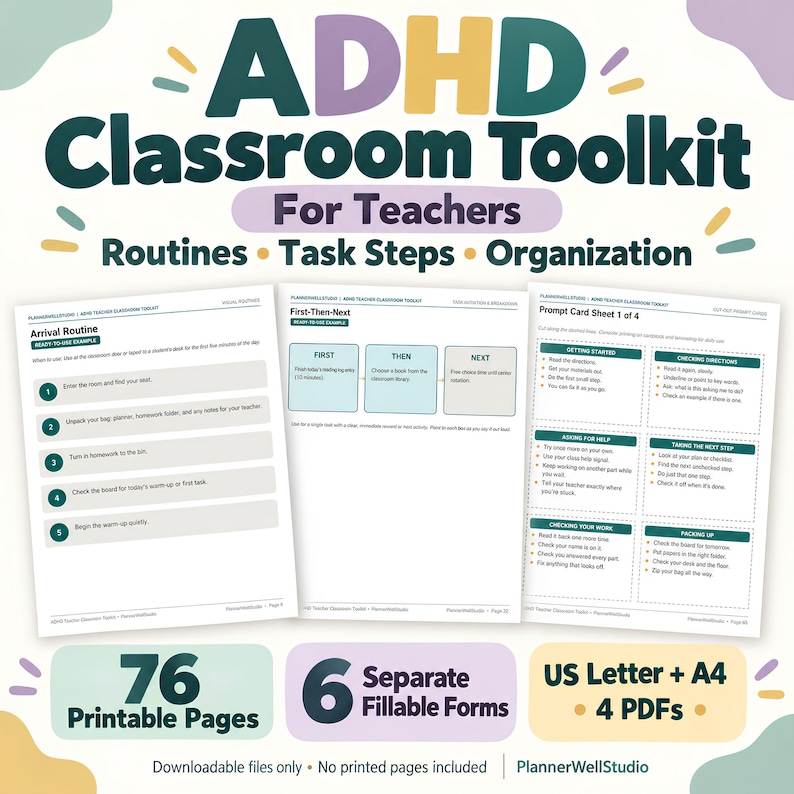
An adhd classroom toolkit is not a box of tricks. It is the set of small, repeatable supports that make an ordinary school day work for a student whose brain processes instructions, time, and transitions differently — and, just as importantly, for the teacher managing twenty-nine other students at the same time. The best ADHD strategies teachers actually use share one quality: they reduce the load on working memory. They show the student what to do, in what order, and how they will know they are finished, instead of asking the student to hold all of that in their head while also doing the work.
That is why visual supports beat verbal reminders in most classrooms. A spoken instruction disappears the moment it is said. A visual routine stays on the wall, on the desk, or in the student's hands, and the student can check it as many times as they need without asking again. The strategies below are the ones that survive contact with a real Tuesday morning: simple to set up, quick to use, and easy to keep going once the novelty wears off.
ADHD Strategies Teachers Actually Use: Start With the Routine
The single highest-value item in any adhd classroom toolkit is a visual routine for the parts of the day that fall apart most often: arrival, independent work, transitions, asking for help, packing up, and the end of the day. Each routine works best as a short sequence of steps the student can see — pictures, short words, or both — posted where the routine happens, not in a folder somewhere else.
Arrival is a good place to start because it sets the tone for everything after it. A five-step arrival strip — hang up your bag, put your folder in the tray, check the board, sit down, start the morning task — turns a chaotic ten minutes into a sequence the student can run on their own. The teacher's job shifts from repeating instructions to pointing at the strip, and over a few weeks the pointing stops too.
Transitions deserve the same treatment. The hardest moments for many students with ADHD are not the tasks themselves but the gaps between them: stopping one thing, moving, and starting another. A visual "first, then, next" board makes the sequence concrete, and a two-minute warning before the change gives the brain time to prepare. Teachers who use a consistent transition routine for the whole class find it helps every student, not only the ones with ADHD — which is exactly why it is worth building into the classroom rather than bolting on for one child.
Break the Task Down Before the Student Has To
Multi-step assignments are where working memory overload shows up most clearly. "Write a paragraph about your weekend" is, for a student with ADHD, actually six tasks: think of an idea, plan three sentences, write the first sentence, remember the spelling of a hard word, keep track of where they are, and finish. An adhd classroom toolkit handles this with task breakdowns: assignment steps pages and work checklists that split the job into one visible step at a time, with a box to tick off each step as it is done.
The tick matters more than it looks. Checking off a finished step gives the student proof of progress, which is the fuel for the next step. Without it, a half-finished page looks like nothing done at all, and motivation collapses. A simple checklist — read the question, underline the key words, write one idea, write the sentence, check it — turns an overwhelming assignment into a series of small wins. For longer projects, a project breakdown page does the same job across days: what is due, in what order, and what "done" looks like for each part.
Student prompt cards work on the same principle in miniature. A small card on the desk — "Did I check my work?" or "Raise your hand if you are stuck" — acts as a quiet external reminder, replacing the teacher's repeated verbal prompt with something the student controls. Cut-out cards the student can keep, move, and flip give them a sense of ownership over the strategy, which is half the reason it keeps working.
Organization Supports That Do the Remembering
A large share of ADHD classroom difficulty is not academic at all — it is lost materials, forgotten homework, and missed due dates. Materials checklists, homework trackers, and due-date pages in an adhd classroom toolkit move that remembering out of the student's head and onto paper. The rule is the same as with routines: the support must live where the task happens. A packing-up checklist on the inside of the desk lid gets used; one in a binder at home does not.
Student check-ins and goal-setting pages add the reflective layer. A short daily check-in — what went well today, what was tricky, one thing to try tomorrow — takes two minutes and builds the self-monitoring skill that students with ADHD find hardest to develop on their own. Over weeks, those check-ins become a record the teacher can actually use: which strategies are helping this student, which ones have stopped working, and what to try next. That record is also gold at parent meetings and support reviews, where "we tried visual routines and they helped with transitions but not with independent work" is far more useful than "he's doing better."
The Teacher Side: Notes, Trials, and Reviews
A toolkit that only serves the student is only half a toolkit. Teachers need pages for their own side of the work: observation notes, support trial logs, strategy reviews, family communication notes, and meeting preparation pages. When you try a new support, log it: what you tried, for how long, and what changed. Without that log, every strategy becomes a vague memory — "I think we tried that" — and the same ideas get tried and dropped in a loop.
A monthly strategy review takes fifteen minutes and pays for itself many times over. Look back at the trial log, keep the two or three supports that are genuinely working, drop the ones that quietly died, and pick one new support to try next month. That rhythm — try, log, review, adjust — is what turns a collection of pages into a system, and it is the difference between a toolkit that gathers dust by November and one that still runs in May.
Start With Three Pages, Not Seventy-Six
The mistake is printing the whole toolkit at once. Start with three pages: one visual routine for the shakiest part of the day, one task breakdown for the assignment type that causes the most friction, and one student check-in page. Use them for two weeks, log what happens, and then add the next pages the evidence points to. An adhd classroom toolkit works when it grows around a real student in a real classroom — one routine, one checklist, one small win at a time.
Ready-to-use help: If you want these supports ready to print — visual routines, first-then-next pages, assignment steps, work checklists, project breakdowns, organization pages, student prompt cards, check-ins, and teacher-facing observation and trial logs — the ADHD Teacher Classroom Toolkit was built for exactly this system: a 76-page printable toolkit in US Letter and A4, plus a fillable PDF of the teacher-facing forms, so you can start with three pages and add the rest as the routine takes hold.
Browse all teacher planners here: https://www.etsy.com/shop/PlannerWellStudio



0 Comments