
Ask a paraprofessional what they carry into a classroom and you will rarely hear a single answer. Some carry a planner: a week spread, a timetable, a to-do list. Some carry a binder: tabbed sections, student pages, data sheets, behavior plans. Most carry something in between — a planner stuffed with loose sheets, or a binder with a calendar shoved in the front pocket — and both versions have the same problem. The question behind every paraeducator planner search is not really "planner or binder." It is: what do I actually need in my hands during the school day, and what is just weight?
A para's day is different from a teacher's day. A teacher plans the lesson; a para lives inside it, moving between students, rooms, and small groups, often without a desk of their own. The right carry system is built around that reality: it must answer three questions fast — where do I need to be, who am I supporting, and what do I need to record — without a search through forty pages.
What a Paraeducator Planner Should Actually Do
A planner is forward-looking. Its job is the week ahead: which rooms, which groups, which students, and what changes on assembly days or indoor recess days. A good paraeducator planner holds the daily schedule block by block, the small-group rotation, and a short prep note for each block — the material to bring, the student to collect, the room to head to next. That is the whole job, and it is enough. When a planner tries to do more — when it becomes a journal, a diary, and a filing cabinet at once — it stops being the thing you check at 8:05 before the first bell.
The planner fails in one predictable way: it has nowhere to put the record of what actually happened. You can write "reading group with Jayden, 10:00" in a planner, but the planner has no honest place for how Jayden did, what prompt level he needed, or what the teacher should know before tomorrow. That record-keeping is not planning. It is documentation, and it needs a different kind of page.
What a Binder Does That a Planner Cannot
A binder is backward-looking, and that is its strength. It holds the working record: one page per student with strengths, supports, what helps and what to avoid; behavior plans written in plain language; data sheets that take seconds to fill in; and a running communication page for notes to the teacher. When a substitute para steps in, the binder is what lets a stranger do a decent job — not the planner, which only says where to be, but the binder, which says who the students are and what to do when the plan meets a real Tuesday.
The binder fails in the opposite way from the planner: it gets fat. Every form ever printed migrates into it, completed sheets never get filed out, and the daily schedule ends up buried behind twenty pages of reference material. A binder that holds everything is a binder nobody opens in a hurry. The pages a para touches every day should be reachable in seconds, and everything else should live in a section that is visited weekly, not hourly.
The Real Question: What Do You Carry, and What Stays in the Room?
Stop asking "planner or binder" and ask two smaller questions instead. First: what do I need on my person between rooms? That is a short list — today's schedule, today's groups, today's data sheets, and the one-page behavior summary for any student whose plan might matter before lunch. Second: what can stay in the classroom? That is the longer list — completed data sheets, the full set of reference pages, last month's communication notes, and anything you only need when you sit down to plan.
Most paras do their best work with a slim carry set and a fuller base binder. The carry set goes with them: a few pages in a clipboard, a slim folder, or the front section of a small binder. The base binder stays in the classroom corner or the resource room, and the carry set gets refreshed from it each morning. When the carry set is separate from the archive, neither one gets bloated, and the thing in your hands is always today's work — not the whole school year.
This split also solves the substitute problem. A substitute para does not need your archive. They need the carry set: the schedule, the snapshots, the plain-language plans, and a fresh data sheet. Hand them that, and they can run the day. Hand them a forty-page binder with no order to it, and they will spend the morning searching instead of supporting.
The Carry Kit That Works: Planner Pages Inside a Binder
The setup that survives contact with a real school year is a hybrid, and it is simpler than it sounds: a binder with a planner section at the front. The front section is the planner — this week's schedule, this week's groups, a daily sheet for each day. Behind it, tabbed sections hold the record — student snapshots, behavior plans, data sheets, and the communication log. One system, two jobs, and the boundary between them is a tab divider.
The rhythm that keeps it alive is small. Monday morning, two minutes: check the week's schedule against the base binder and refresh the carry pages. During the day, seconds at a time: data goes on the day's sheet as the session happens, not reconstructed at 3:30. Friday, five minutes with the teacher: file the week's completed sheets, clear anything resolved from the communication page, and note next week's known changes on the schedule. That Friday habit is the same one behind my post on Caseload Management for SPED Teachers: A Weekly 15-Minute Routine — a short, fixed review beats a big, occasional cleanout every time.
A note on privacy, because it decides what travels: the carry set holds student information, so it stays at school, out of public view, and follows your school's rules for student records. The slimmer the carry set, the easier that rule is to keep. Leave full formal documents in the office file where they belong; the carry set needs the working summary, not the whole record.
What to Leave Out
If a page has not been opened in a month, take it out of the carry set — and probably out of the binder too. Whole IEP copies, duplicate forms, last term's schedules, and personal notes that duplicate the communication log are the usual suspects. A carry system earns trust by being light, current, and complete for today. Every page you remove makes the pages that remain faster to find.
Start with one week. Build the front section — schedule, groups, daily sheets — and one snapshot page per student you support, and run it for five school days. At the end of the week, ask what you reached for, what you never touched, and what you wished you had. Then adjust once, and keep the shape. The paraeducator planner that lasts until May is not the biggest one. It is the one that holds today's work, today's students, and today's record — and nothing else.
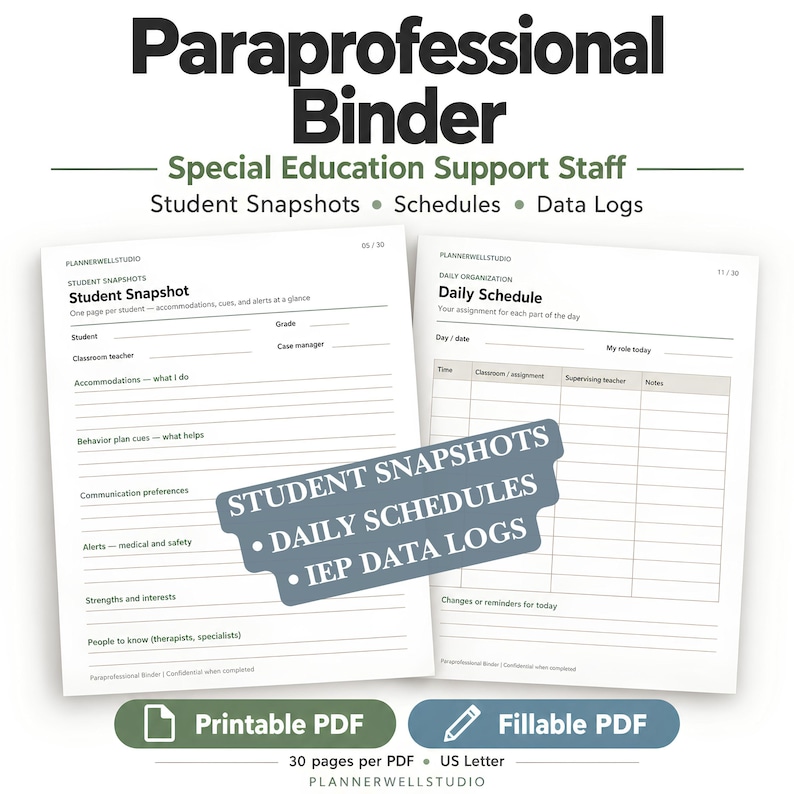
Ready-to-use help: If you want the schedule pages, student snapshots, small-group session logs, IEP goal data sheets, behavior quick-capture forms, and teacher communication log ready to print, the Paraprofessional Binder was built for exactly this carry system — printable and fillable PDF, $12.99, one binder that works as both planner and record. The same binder is also on Payhip here: https://payhip.com/b/iDqEc
Browse all teacher planners here: https://www.etsy.com/shop/PlannerWellStudio
Start today. Pull out today's schedule, today's groups, and today's data sheets — and leave the rest of the year in the room where it belongs.



0 Comments