
Every special education teacher has had the same sinking moment: a test is halfway through, a student looks up confused, and you realise the accommodation written in their IEP — the one you meant to set up this morning — never happened. Not because you did not care. Because the school day moved faster than the plan did. The accommodation was in the IEP document, in the meeting notes, maybe even on a sticky note on your desk, but it was not in the one place that matters on test day: the working record you actually check before the lesson starts. That is exactly the gap an iep accommodation tracker is built to close.
An IEP is a legal promise, but a promise kept only in a file cabinet is not much use to a student sitting in front of a test paper. Accommodations only work when they are delivered, every time, for every student who needs them — and delivered means tracked. If you cannot say, for a given week, which accommodations each student received and which ones slipped, you are relying on memory in a job where memory is the first thing the day takes from you.
Why Accommodations Get Missed (Even by Good Teachers)
Accommodations get missed for predictable reasons, and none of them are laziness. First, they are scattered. One student's extended time is in the IEP, another's read-aloud accommodation is in an email from the case manager, and a third student's preferential seating is something you agreed at a meeting three months ago and never wrote down anywhere official. When the information lives in five places, the version you act on is whichever one you happen to find first.
Second, accommodations are invisible until they are needed. A seating accommodation matters when the room changes. A testing accommodation matters on test day. A chunked-assignment accommodation matters when you hand out the week's work. Between those moments, there is nothing reminding you the accommodation exists — until the moment has already passed.
Third, caseloads are large. A teacher supporting ten, fifteen, or twenty students with IEPs cannot hold every student's accommodation list in their head alongside lesson plans, grading, and meetings. The teachers who never miss an accommodation are not the ones with the best memories. They are the ones with a system that remembers for them.
What an IEP Accommodation Tracker Actually Holds
An iep accommodation tracker is not a copy of the IEP. It is the working translation of the IEP into daily classroom actions, kept in one place and checked on a routine.
One page per student. Each student's accommodations, written in plain words, not meeting language. "Extended time" becomes "time-and-a-half on all assessments; timer set before the test starts." "Preferential seating" becomes "front row, away from the door, clear view of the board." When a substitute teacher covers your class, that page tells them exactly what to do without them needing to read the full IEP.
An at-a-glance caseload overview. A single spread showing every student and their key accommodations side by side. This is the page you check while planning a lesson: who needs what for this activity, before you prepare the materials, not after you have handed them out.
A weekly tracking log. For each week, a simple mark per student per accommodation: provided, not applicable that week, or missed — with a note when something slipped and why. The log is filled in on Friday, when you close out the week, and it takes minutes. Over a month, it shows patterns a memory never would: the accommodation that keeps slipping on test days, the student whose seating plan broke down after the room rearrangement, the testing accommodation that works fine in your class but not in co-taught periods.
A testing-day planner. Testing accommodations fail most often because they need preparation the week before, not on the morning of the test: a small-group room to book, a reader to arrange, extra time to build into the schedule. A testing-day page per assessment, listing which students need which testing accommodations and what has been set up for each, turns test week from a scramble into a checklist.
Review and meeting pages. Accommodation review dates, kept visible at the start of each month, so no annual review arrives as a surprise. And a short note of each accommodation-related conversation — with the case manager, a parent, a co-teacher — written the same day: who, when, what was agreed. Small entries now are what keep a caseload from quietly falling behind later.
The Weekly 10-Minute Routine That Keeps It Alive
A tracker only works if updating it is faster than avoiding it. This routine takes about ten minutes a week:
- Monday, while planning: glance at the at-a-glance overview for the students you teach that week. Note any accommodation that changes how you prepare a lesson or an assessment.
- Before a test: open the testing-day planner, confirm each testing accommodation is set up, and book anything that is not.
- Friday, ten minutes: fill in the weekly log. Mark what was provided, flag what slipped, and fix the slip for next week while it is still fresh — move the seat, rebook the room, tell the co-teacher.
That is the whole system. The tracker does not add work to your week; it moves the work from frantic reconstruction at progress-report time to ten calm minutes on Friday.
Documentation: The Part That Protects Everyone
Documentation is the least popular part of an IEP and the part that matters most when it counts. Most teachers implement accommodations faithfully and record almost none of it, because recording feels like extra work on top of teaching. The fix is to make the record part of the routine, not an extra task: mark the weekly log on Friday when you close out the week, note a testing accommodation in the testing-day planner when you set the test up, and check the review dates at the start of the month when you check your calendar anyway.
That habit protects the student first. A plan that is documented is a plan that survives a substitute day, a timetable change, and a new teacher joining the team mid-year. It also protects you. If a parent asks whether an accommodation was provided, or a coordinator reviews implementation before a meeting, a tracker with weekly logs answers the question in seconds, with dates. A memory answers it with "I think so."
Start With Your Hardest Week, Not Your Whole Caseload
Do not migrate your whole caseload in one sitting. Pick the students whose accommodations are easiest to forget — the ones whose testing accommodations need booking, or whose seating changed recently — set up one page per student, and run the Friday routine for a month. When the next test week arrives and every accommodation is set up before the first paper goes out, you will not need convincing to move the rest of the caseload into the tracker.
An iep accommodation tracker earns its place in your classroom not by being complete, but by being used — every week, in minutes, without a second thought. The students on your caseload do not need a perfect system. They need the accommodations in their IEPs to actually happen, every time, and a tracker is what makes "every time" achievable on an ordinary school week.
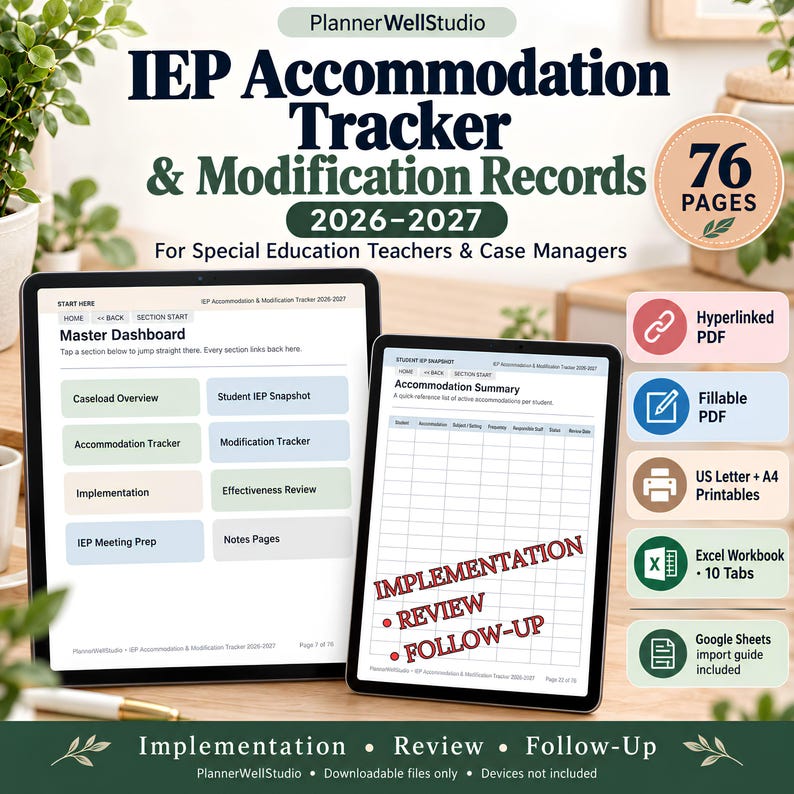
Ready-to-use help: If you want the tracker pages ready to print — the at-a-glance caseload overview, one page per student, weekly tracking logs, testing-day planner, and review pages — the IEP Accommodation Tracker was built for exactly this routine: a printable and fillable PDF for special education teachers who need every accommodation delivered and documented.
Browse all teacher planners here: https://www.etsy.com/shop/PlannerWellStudio



0 Comments