
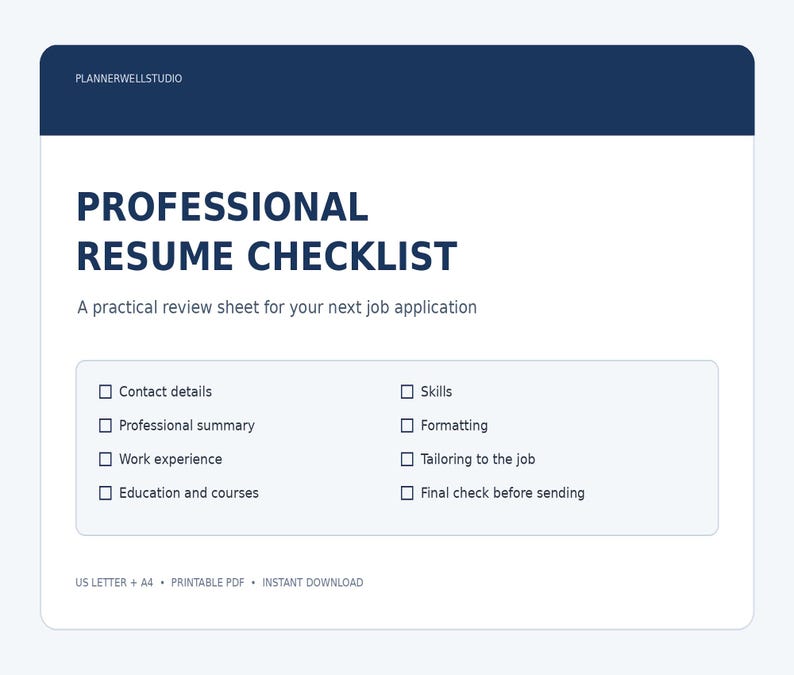
A resume rarely gets rejected because the person behind it is unqualified. It gets rejected because of a detail nobody caught: a phone number with a wrong digit, a job title from two roles ago, a summary that says nothing, or a file named "resume-final-FINAL-v3" sent to the wrong posting. The person who wrote it read it four times and missed all of it, because reading your own resume is the worst way to check your own resume. Your eyes fill in what you meant to write. That is exactly what a resume checklist printable is for: it takes the checking out of your head and puts it on paper, one item at a time, so nothing gets skipped because you were tired or in a hurry.
The checklist works because it changes the job. Instead of "read the resume again and hope you spot the problem," it gives you eight small reviews, each with its own list of boxes to tick. You work through them in order, pen in hand, and by the end you have checked the resume the way a hiring manager will read it — fast, in order, and with no patience for confusion.
Why a Checklist Beats a Final Read-Through
A read-through feels thorough and usually is not. When you read your own writing, your brain auto-corrects: it sees the number you intended, not the number you typed, and it skips the line you already know by heart. A checklist breaks that pattern in three ways.
First, it forces slowness. Each box asks about one thing — is the email address current, are the dates consistent, does the summary name the role — so you look at that one thing instead of gliding over the page. Second, it separates the checks. Contact details, experience, formatting and tailoring are different kinds of errors, and they hide from each other when you check everything at once. Third, it leaves a record. A ticked box says the check happened; an empty box says it did not. When you send the application, you know which parts were actually verified and which you only meant to get to.
That matters most when you are applying for more than one role. The fifth application gets less attention than the first, and that is when the old summary, the wrong company name, or the un-updated skills list slips through. A printed checklist makes the fifth review as careful as the first, because the list does not get tired.
The 8-Part Review, Section by Section
The review runs in the order a reader meets your resume. Start at the top and work down.
Contact details. Name, phone, email, links. Check every character: one wrong digit in a phone number means the call never comes, and an old email address means the reply goes to an inbox you no longer open. If you list a portfolio or LinkedIn link, open it and confirm it works and shows the right profile.
Professional summary. Short, specific, and tailored to the role. A summary that could belong to anyone — "hardworking professional seeking new opportunities" — tells the reader nothing. The summary should name the role, the experience that fits it, and one result. If it reads the same for every job you apply for, it is not finished.
Work experience. Order, action verbs, results, dates. The most recent role comes first, each role starts with a strong verb, and each bullet shows a result where one exists — not just what you did, but what changed because you did it. Dates must be consistent in format and free of gaps nobody can explain.
Education and courses. Qualifications, certifications, and GPA guidance where it helps. List what is relevant and current, and leave off the course you finished six years ago that has nothing to do with this role. If a certification has expired, either renew it or remove it.
Skills. Relevant, grouped, and honestly stated. Group them so a reader can scan — technical skills together, tools together — and remove anything you could not actually do in an interview. A skills list that overpromises is worse than a short one, because the interview will find out.
Formatting. Clean font, consistent dates, and an ATS-friendly layout. One font, one way of writing dates, headings that a tracking system can read. Fancy columns, tables and graphics may look good on screen and break completely in an applicant tracking system, so the check here is simple: does the layout survive being read by a machine as well as by a person?
Tailoring to the job. Keywords from the posting, relevant experience first. This is the step most people skip, and it is the one that decides whether the resume gets past the first screen. Mirror the language of the posting where it is honest to do so, and move the experience that matches this role to the top of its section.
Final check before sending. Spelling, file name, correct attachment. Read it once out loud — your ears catch what your eyes miss — then check the file name, confirm you attached the right version, and confirm it is going to the right posting. The checklist ends here, not at the formatting section, because the sending step has its own mistakes.
How to Use This Resume Checklist Printable in 15 Minutes
Print the checklist and work through it with a pen, one section at a time, with the job posting open beside you. Fifteen minutes is enough when the checks are small: two minutes on contact details and summary, five on experience and education, three on skills and formatting, three on tailoring, and two on the final check. Tick each box as you verify it, and fix what you find before moving on — a checklist you fill in after fixing nothing is just a piece of paper.
Use a fresh print for each application. The tailoring section changes every time, so a reused checklist carries yesterday's answers into today's application. Three pages, printed in US Letter or A4, is all it takes: print, tick, fix, send. And keep the completed checklist with the application for a day or two, so if the employer calls, you know exactly which version of your resume they are looking at.
The Mistakes a Checklist Catches
The errors that cost interviews are almost never dramatic. They are the phone number with two digits swapped, the summary written for a different role, the skills list that still names a tool you stopped using years ago, and the resume sent as "resume-FINAL" that was actually the draft. None of them means you are unqualified. All of them mean the reader never finds out whether you are.
A checklist also catches the quieter problem: the resume that is technically correct but says nothing. When the summary box asks "does this name the role and one result," a generic summary fails the check in plain sight, and you can rewrite it before anyone else reads it. That is the real value of the review — not catching typos, but catching the resume that would have been skipped for being forgettable.
Ready-to-use help: If you want the full 8-part review ready to print, the Resume Checklist Printable was built for exactly this habit — a 3-page printable PDF in US Letter and A4, walking you through contact details, summary, experience, education, skills, formatting, tailoring, and one final check before you send. The same checklist is also on Payhip here: https://payhip.com/b/ZYT7e
Browse all teacher planners here: https://www.etsy.com/shop/PlannerWellStudio
Start with the application you are about to send. Print the checklist, work through the eight sections with a pen, and tick every box before you attach the file. Fifteen minutes now is cheaper than a missed call that never comes.



0 Comments