
Every teacher knows the morning it happens. You wake up unwell, or a family emergency pulls you away, and instead of resting you spend an hour typing frantic notes, trying to remember which class needs what, where the seating chart lives, and what the early finishers are supposed to do. A substitute teacher planner exists so that morning never has to go that way. When the binder is ready before the bell, an absence becomes a handover, not a crisis — for you, for the substitute, and for your students.
The point of a substitute teacher planner is not to write a perfect lesson plan for a stranger. It is to answer, in one place, the questions a substitute will actually ask during the day: Where do I go? What happens when? Who needs what? What do I do when something goes off script? If those answers live in a binder on your desk, any capable substitute can run your classroom. If they live only in your head, even a great substitute spends the day guessing.
What a Substitute Teacher Planner Must Cover
A useful substitute teacher planner starts with the classroom snapshot, not the lesson. The substitute needs your room number, the school day timings, where to find supplies, who to ask for help, and the names of the colleagues next door. That one page saves more time than any lesson plan, because a substitute who cannot find the whiteboard markers or the lunch count sheet loses the first twenty minutes of the day.
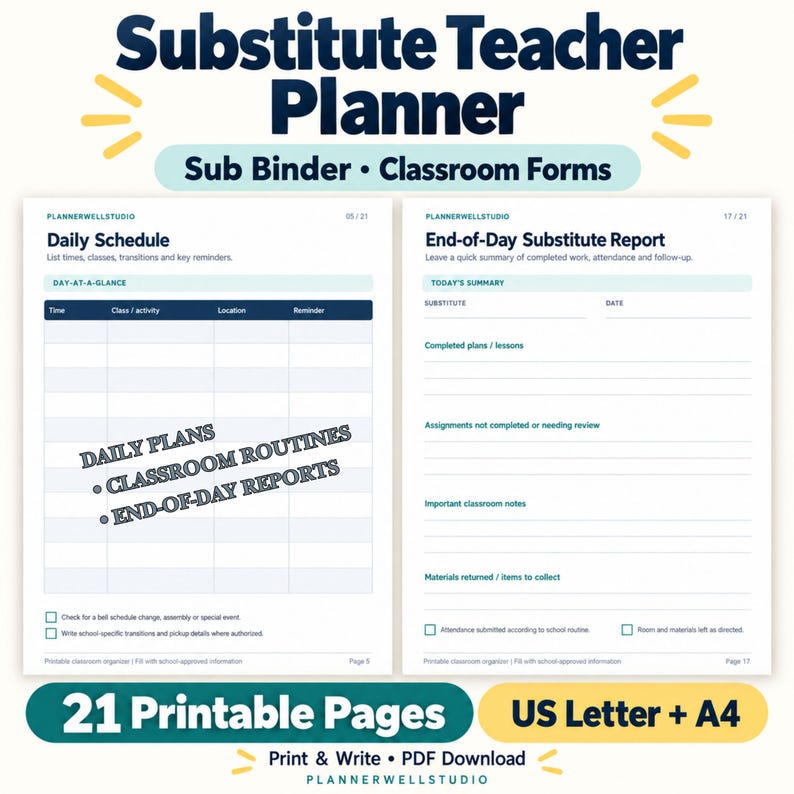
Next comes the daily schedule, class by class. Not just the times, but what actually happens in each block: where students sit, how transitions work, and which routines never change. A substitute teacher planner that lists routines and expectations alongside the schedule keeps the day feeling normal for students, which is half the behavior management done before the first lesson starts.
Then the working pages: attendance, seating charts, lesson and assignment plans, and materials notes. These are the pages the substitute touches all day, so they need to be quick to read and quick to fill in. A seating chart with names in place beats a class list every time. An assignment page that says what was set, what was collected, and what was left unfinished beats a paragraph of explanation.
The Pages Teachers Forget (and Subs Need Most)
Most sub plans cover the lessons and forget the edges of the day, and the edges are where substitute days fall apart. A good substitute teacher planner therefore includes the pages teachers usually leave out:
- Student notes and teacher-approved supports. Not private records — just the practical facts a substitute needs: who has a support plan to follow, who should sit near the front, and which strategies actually work for which student. Written briefly and factually, this page protects students far better than a verbal warning passed on in the corridor.
- Early finisher activities. Every class has students who finish in ten minutes and students who need forty. Without a plan for the fast finishers, the substitute spends the last part of every lesson managing restlessness instead of helping the students still working.
- The end-of-day substitute report. This is the page that makes the next morning work. What was completed, what was not, any behavior notes worth knowing, and anything left for you to follow up. A substitute who writes this down gives you your classroom back in five minutes the next morning; a substitute who does not leaves you reconstructing the day from student reports.
- A class completion check and a teacher-prep checklist. The completion check shows at a glance which classes finished what. The prep checklist is for you, before the absence: print the pages, fill the snapshot, update the schedule, and leave the binder where the substitute will actually see it.
Building Your Sub Binder Before You Need It
Do not build a substitute teacher planner on the morning you are absent. Build it in a calm week, in about an hour, and then keep it current with a five-minute update whenever something changes. Start with the snapshot and the schedule, because those two pages carry the day on their own. Add the routines and expectations next, then the seating charts and attendance pages. Fill in the lesson and assignment pages last, with the plans for the current unit, and leave blank copies behind them so the substitute can note what actually happened.
Keep the binder in the same place every day, and tell your team where it is. A sub binder in a drawer nobody opens is no better than no binder at all. Many teachers keep it on their desk with a clear label, plus a note for the office saying where it lives. If your school has a cover folder or a shared drive for emergency plans, put a copy there too — the binder on the desk is the working copy, and the office copy is the backup.
Update it the way you would any classroom system: when the seating plan changes, swap the chart. When the schedule changes after a timetable shuffle, swap the schedule page. When a routine changes, change the routines page, not just your memory of it. A substitute teacher planner only stays trustworthy if the substitute can trust that the pages match the classroom they walk into.
Paper, Tablet, or Both
A printed binder suits most substitute days, because a substitute can flip pages, tick boxes, and leave handwritten notes without learning a new app or hunting for a charger. A tablet version suits teachers who update plans often and want to print fresh pages only when needed. Many teachers run both: the printable set lives in the binder on the desk, and the digital file lives on their computer so a new seating chart or schedule page can be printed in minutes. The format matters less than the rule behind it — one binder, in one known place, with the whole day inside it.
If you want that system ready-made, my Substitute Teacher Binder is a 21-page printable set in US Letter and A4, built on exactly these pages: teacher and classroom snapshot, school contacts and room guide, daily schedule, class-by-class plans, classroom routines and expectations, attendance record, seating chart, lesson and assignment plan, materials and room notes, student notes and teacher-approved supports, early finisher activities, factual classroom notes, end-of-day substitute report, class completion check, teacher-prep checklist, and notes pages. Print the full set or just the pages you need.
Start With the Snapshot
Do not try to write the perfect sub plan in one sitting. Start with the snapshot page and the daily schedule, print them, and put them in a binder on your desk. Then add one section a week until the binder holds a full day. The next time you wake up unable to go in, you will not spend the morning writing frantic notes. You will send one message — the binder is on my desk — and rest, knowing your classroom is covered.
Ready-to-use help: Get the Substitute Teacher Binder on Etsy — a 21-page printable substitute teacher planner in US Letter and A4.
Browse all teacher planners here: https://www.etsy.com/shop/PlannerWellStudio



0 Comments